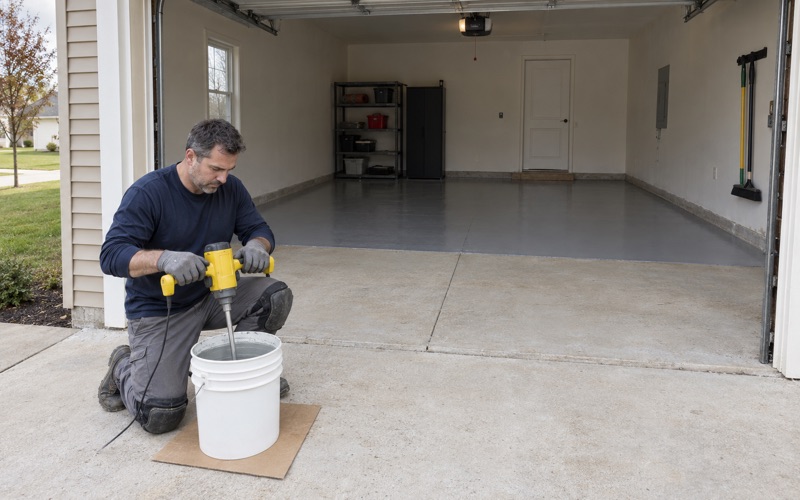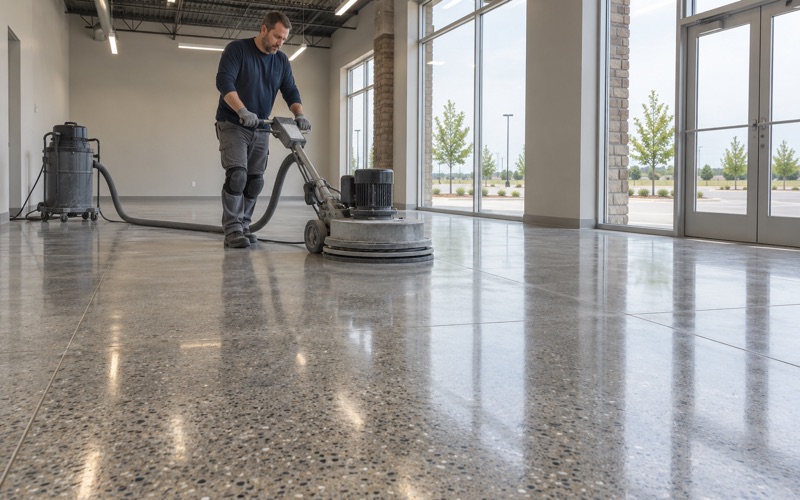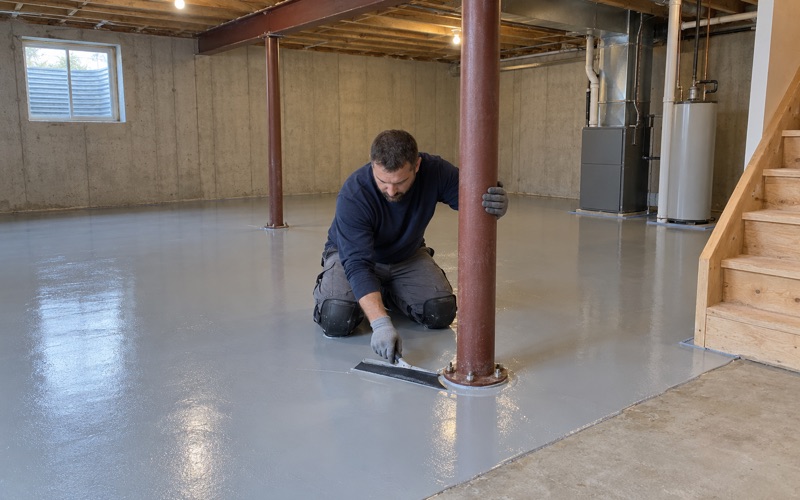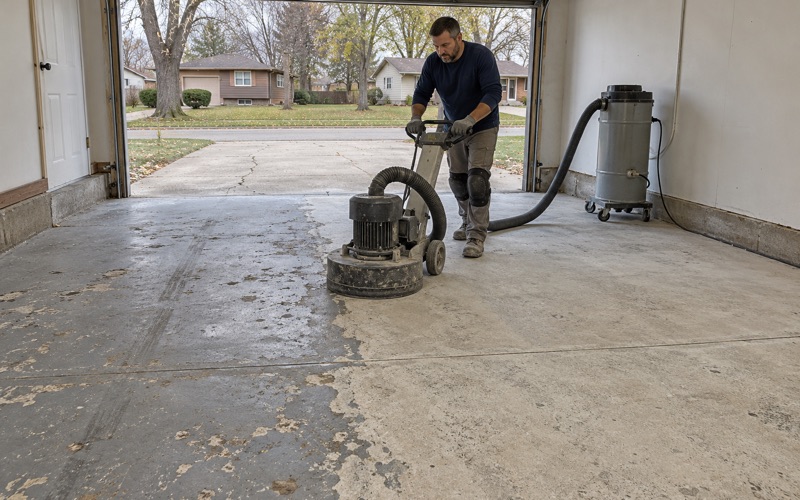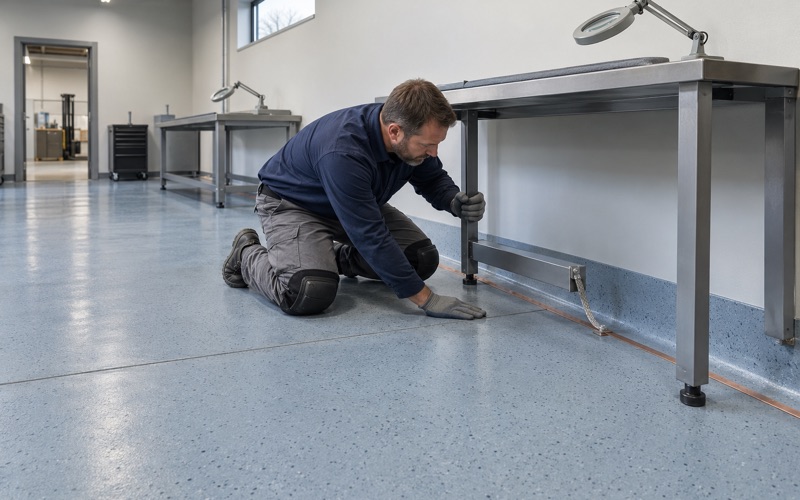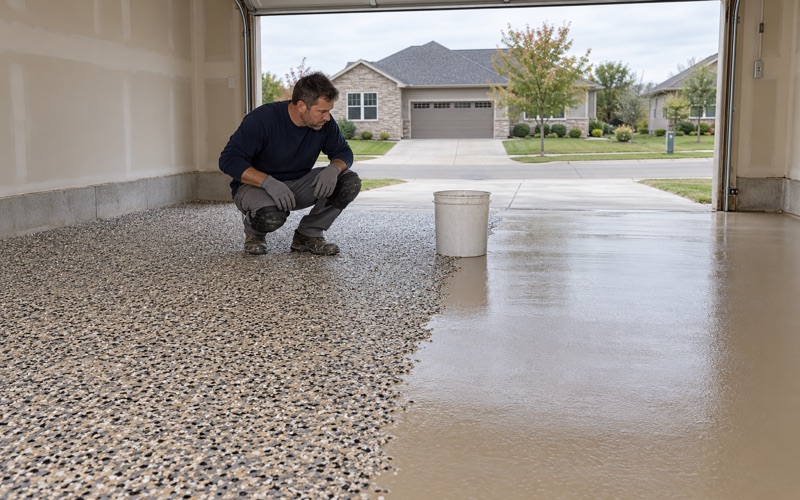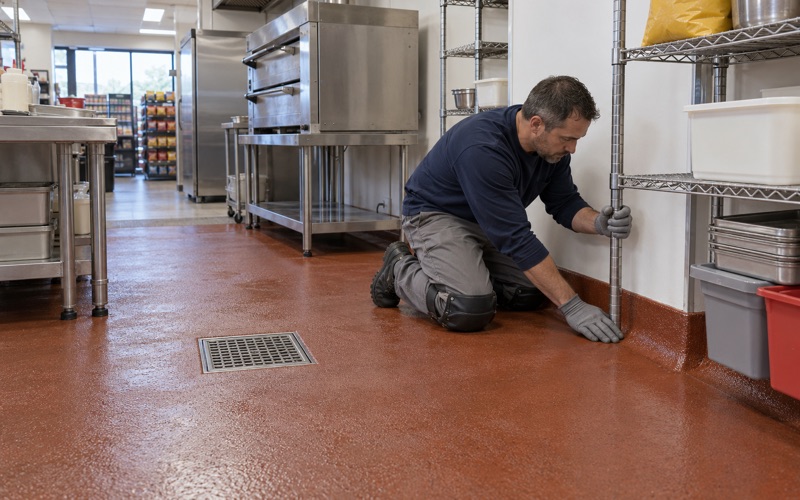
Ankeny Epoxy Flooring has spent more than 20 years on epoxy flooring in Adel and the rest of central Iowa, and the work starts the same way on every slab. We open the concrete with a diamond grinder or a shot blaster, never an acid etch, so the coating has a real profile to grip. Then we test for moisture before the price is final, because a number on paper means little until the slab has told us what it holds.
Our written proposal names the product line, the number of coats and the finished thickness, which lets anyone hold the finished floor against the quote. Before that proposal goes out, we map cracks, spalls and old coatings, and we say plainly when a slab needs repair or replacement before it should be coated. We also explain what a coating warranty leaves out, and moisture is the first exclusion we name.
That paper trail matters more in this town than in most. A good share of the floor area here belongs to a county, a city or a school district, and public owners buy floor work under a state statute with its own steps. This page walks through how that process works, so a facilities manager, a board member or a homeowner curious about the courthouse knows what the rules ask of anyone who bids.
The Courthouse Square and the County’s New Administration Building
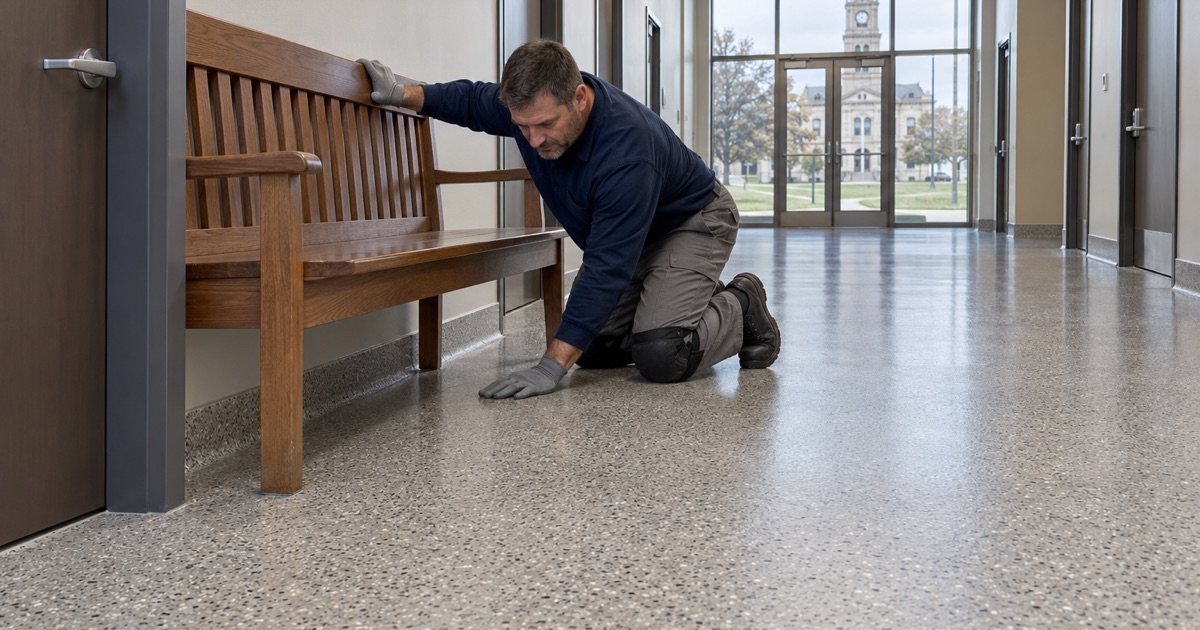
A county seat with a lot of public floor
Adel is the Dallas County seat, a city of 6,153 people at the 2020 Census, set along the North Raccoon River. Being the seat means the county’s courts, offices and records are concentrated here, and that shapes who owns the larger buildings in town. Alongside the county, the City of Adel and the Adel-DeSoto-Minburn school district are both owners of public floor space.
The 1902 courthouse on the Public Square is built of Bedford stone and was modeled after a French castle, and the brick streets around it are the historic structure of the square’s district. Its courtrooms and hallways have been repainted in original colors and the rotunda restored. We mention it here as the anchor of the square, not as a building we have worked on.
The administration building on the north side
In August 2023, crews broke ground on a two-story, 54,000-square-foot county administration building at Court and Nile Kinnick Drive South, on the north side of the square. It was reported as a 25 million dollar project, including 10 million dollars from ARPA, and it was planned for the Assessor, the Board of Supervisors, IT, the Treasurer and the Recorder.
Offices like these take steady foot traffic, rolling carts and winter boots carrying slush across the threshold. When a building of that size needs floor work in a lobby, corridor or service room, the job will not be a phone call and a handshake. It will run through the state’s public bidding law, which is where most of the rest of this page lives.
A new high school on the south side
The ADM district passed a 58 million dollar bond in November 2023 and is building a new 1,000-student high school on 80 acres along Highway 169 on the south side of Adel. The construction contract went to Stahl Construction in March 2025, ground was broken in June 2025, and the district anticipates completion in summer 2027.
We name the school only as another public owner in town. A district with a new building on the way and its current middle and high school planned for a refresh as a grades 5-8 building will buy floor work for years, and every purchase above the statute’s limits follows the same rules the county follows.
Looking for epoxy-flooring closer to Indianola? See Epoxy-Flooring Services in Indianola.
When a Floor Job Becomes a Public Improvement
What Iowa Code chapter 26 covers
Iowa Code chapter 26, the Iowa Construction Bidding Procedures Act, governs public improvements let by the state’s political subdivisions and public school corporations. A public improvement is building or construction work done under the control of a governmental entity and paid for in whole or in part with its funds. A contracted epoxy system in a county office, a city building or a school fits that description.
That means the county, the City of Adel and ADM all buy coating work through the same framework, even though their dollar limits differ. For a contractor, the practical effect is that the scope has to be written down in a form someone else can price against. Our habit of naming product, coats and thickness on paper is exactly what that process needs.
Custodial upkeep versus contracted coating work
The statute draws a line that matters for floors. Emergency work, and repair or maintenance work performed by a governmental entity’s own employees, is excluded from the definition of a public improvement. Repair or maintenance means preserving a building so it stays in sound or proper condition.
So a custodial crew stripping and refinishing a hallway floor is not something the county lets for bids. Once the job moves to grinding a slab, priming it and building a resin system by an outside contractor, it is contracted work and the chapter 26 steps apply once its estimated cost crosses the limits below.
A spec that holds up in a public process names its test methods. We write in ASTM F2170 in-situ relative humidity probes or ASTM F1869 calcium chloride testing, the ICRI concrete surface profile the grinder must reach, and whether the system is 100% solids epoxy under a polyaspartic topcoat, or urethane cement where a wet area calls for it. Two bidders reading that page are pricing the same floor.
Two Written Quotes, or Sealed Bids and a Hearing
The quotation thresholds
Below the bid threshold, chapter 26 still asks for competition on mid-sized jobs. The statute sets quotation thresholds of 67,000 dollars for a county and 36,000 dollars for a city or school district with fewer than 50,000 people, and the City of Adel falls in that second group. Above those amounts, the owner makes a good-faith effort to get quotations from at least two contractors regularly engaged in the work.
Those figures are the defaults written into section 26.14, and they apply unless adjusted under section 314.1B. We have not read the current adjusted numbers, so anyone planning a project should confirm them with the owner rather than take ours as current. At the quotation level, the winning contractor also cannot start until its performance and payment bond has been approved.
Sealed bids above 100,000 dollars
When the estimated total cost exceeds the competitive bid threshold of 100,000 dollars, or the adjusted figure, section 26.3 requires the owner to advertise for sealed bids. The notice is posted 13 to 45 days before the bids are filed, which sets a minimum on how fast a large public coating job can move from plan to contract.
Section 26.12 adds a public hearing on the plans, specifications, form of contract and estimated cost. For a floor project, that is where a moisture-mitigation primer, a crack-repair allowance or a phased schedule either appears in the specification or does not. Items left out at the hearing tend to come back later as change orders.
Why the written scope carries the weight
Section 26.16 bars owners from prequalifying bidders by experience on similar projects, size of company, union membership or other criteria. With the field that open, the specification is the main thing standing between the owner and a cheap bid that skips the grinding or the moisture test.
That is why we push for test methods and thresholds in writing, such as an ASTM F710 moisture limit or a minimum surface profile, rather than a brand name and the word equal. A clear scope protects the owner, and it protects every honest bidder from being undercut by one who plans to acid etch.
Entry floors in public buildings are a good example. We specify slip-resistant texture by the broadcast and topcoat, such as a quartz aggregate broadcast locked under the final coat, and we pick systems that hold up to the rock salt and brine that ride in from November through March. Written that way, a reviewer can check the texture on site instead of trusting a promise.
Bid Security, Performance Bonds and No Splitting
Security with the bid, a bond with the contract
Section 26.8 requires bid security of at least 5 percent with each sealed bid. The successful bidder then furnishes a corporate surety bond for faithful performance equal to 100 percent of the contract amount, so the owner is covered if the work is not finished as specified.
We want to be plain about our own position. We are not an approved vendor to Dallas County, the City of Adel or ADM, and we have not worked on any of their buildings. A public owner should verify the bonding of whoever submits a bid, and nothing on this page should be read as a claim about ours.
No dividing the project
Section 26.5 says an owner shall not divide a project into separate parts when a resulting part would not be let under the sealed-bid rules. A large floor cannot be carved into a hallway contract, a lobby contract and a stair contract just to keep each one under 100,000 dollars.
Phasing is different from splitting. One contract can still run in stages, with a wing done over a weekend and the next wing the following week, so offices stay open while the grinding and coating move through. We plan that kind of sequence on commercial floors as a matter of course.
Grinding inside an occupied public building also raises a dust question. We capture dust at the machine with a vacuum rather than rinsing it toward a floor drain or storm inlet, which suits a working office and keeps slurry out of the storm system.
What the bond does not change about the slab
A performance bond backs faithful performance of the contract, not the chemistry of the floor. If the slab under an office wing carries more moisture vapor than the system tolerates, the coating can blister no matter who installed it, so the test belongs in the scope rather than in a dispute afterward.
Cure timing is the other variable a bond cannot cover. We schedule by slab temperature and the dew point spread at the surface, not by the calendar, and a winter job in an unheated space is told to wait. Well-drained Clarion loam sits on the rise by the square, but soil is no substitute for a test, and no floor coating is waterproofing, radon mitigation or flood protection.
- 20+ Years on Concrete
- Moisture Tested Before Pricing
- Ground, Never Acid Etched