
Ankeny Epoxy Flooring installs basement floor epoxy in Ankeny, IA, serving surrounding cities including Saylorville, Johnston, Polk City, Bondurant and Altoona. In 20+ years of basement work we have learned that the first question is never color or chip size. It is whether the slab has ever had water on it, and whether moisture is still moving through it now.
A basement slab sits below grade, in soil that stays damp for much of the year, and some of Ankeny’s ground is poorly drained. That does not make a coated basement floor a bad idea, but it does mean the job has to begin with a look at the sump pit, the drain tile and the slab itself before anyone talks about finishes.
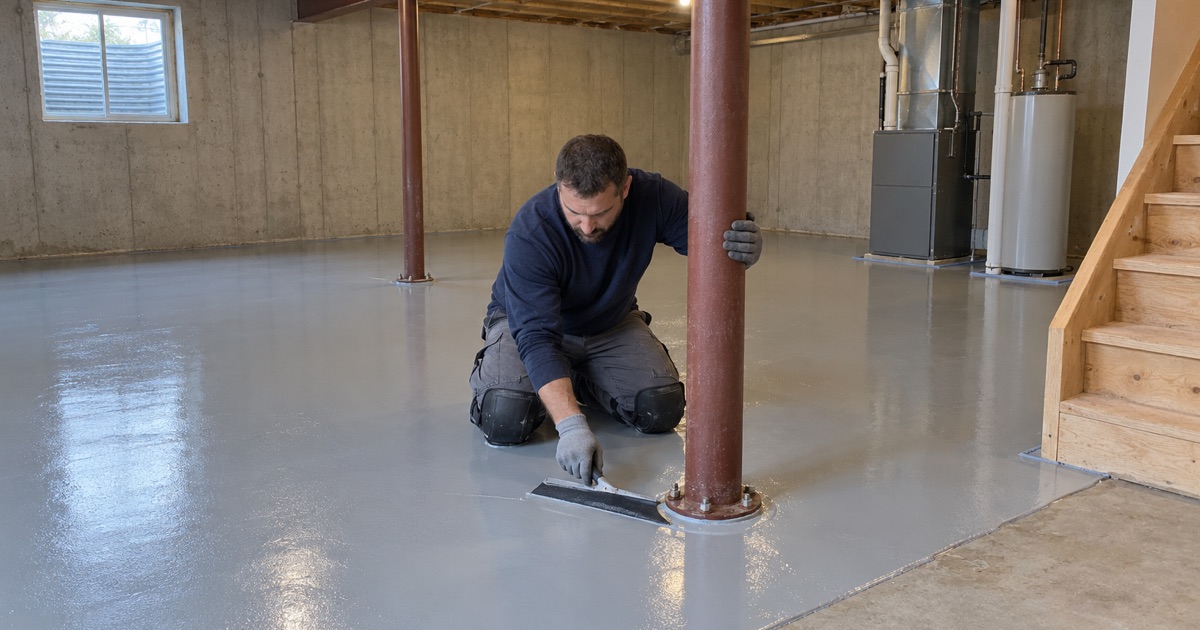
Our basement proposals include the moisture reading, the repairs, the primer and the system, with the product line, number of coats and finished thickness written out. We also explain what a coating cannot do, so the floor you get matches what you expected from it.
Reading the Basement Before It Is Coated
Signs of Past Water
We start by looking for the marks water leaves behind: tide lines on the walls, stains at the base of the foundation, rust on the bottom of shelving, and damp or discolored spots on the slab. Each one tells us where water has come from and how often.
Polk County’s hazard plan rates flash flooding as Ankeny’s highest flood hazard, and in a house that usually shows up as basement water after a heavy storm. If a basement has taken on water before, we want to know when and how, because that history shapes both the test and the system we recommend.
The Sump Pit and Drain Tile
New Ankeny houses are drawn with drainage tile around the footings and a sump pit on the foundation plan, and that system is what keeps groundwater away from the slab. Before coating, we lift the sump lid, check that the pump runs and that the tile is discharging into the pit.
The coating finishes cleanly at the rim of the pit and around every floor drain without sealing anything shut. If the pump has failed, the discharge line is blocked or water is coming in faster than the pit can handle, that gets fixed before we put anything on the floor.
Efflorescence and White Powder
A white, crusty or powdery film on a basement floor is efflorescence, the mineral salts left behind as water moves through the concrete and evaporates at the surface. It can be brushed away, but it comes back as long as moisture keeps moving.
We treat efflorescence as evidence rather than dirt. It tells us where to place our moisture tests, and it warns us that a standard primer may not be enough. Coating over active efflorescence traps the salts and the moisture under the film, where they push the coating off.
Testing and Treating Moisture
Moisture Tests and Thresholds
The quick screen is the ASTM D4263 plastic sheet test, which shows whether moisture collects under a taped square of plastic. For a number we can design around, we use calcium chloride testing under ASTM F1869 or in-situ relative humidity probes under ASTM F2170.
Those readings are compared against the coating maker’s limits and the guidance in ASTM F710 for preparing a slab to receive a floor. The results are written into the scope before the price is final, so the system we install answers what your slab actually measured.
Moisture-Mitigation Primer
When a slab’s readings are above what the coating can tolerate, a moisture-mitigation primer goes on first. It is a dense epoxy that penetrates the concrete and forms a barrier against vapor drive, so the decorative system on top stays bonded.
The primer adds cost and a step, which is why we only use it where the numbers call for it. It handles vapor coming through sound concrete. It does not handle liquid water flowing through cracks or a high water table pushing up from below.
Hydrostatic Pressure and Why a Coating Is Not Waterproofing
Hydrostatic pressure is the force of groundwater pushing up against the underside of a slab when the soil around it is saturated. In parts of Ankeny with poorly drained Webster and Canisteo soils, the seasonal water table can sit close enough to make that a real concern.
No floor coating can hold back water under pressure, and we never describe one as waterproofing. If a basement floor shows active water, the answer is drainage, the sump system or grading, and the coating comes after that work rather than in place of it.
Preparing the Basement Slab
Old Paint, Patches and Tile Adhesive
Many basement floors have been painted, patched or tiled at some point. Porch paint, leveling compound and black adhesive from old vinyl tile all have to come off down to sound concrete, because a new coating will only stay where the material under it stays.
Old black cutback adhesive can contain asbestos, so on older floors we ask about the floor’s history and test before grinding when there is any doubt. On newer houses the slab is often bare, which makes preparation simpler and the job less costly.
Cracks, Spalls and Uneven Areas
We map cracks, spalls, low spots and old patches before quoting. Static shrinkage cracks are filled and ground flush, damaged areas are rebuilt with repair mortar, and low spots near drains are left to drain rather than filled level.
A crack with one side higher than the other, or one that lets water through, is a sign of movement or a water path. We point those out and tell you when a structural or drainage specialist should look at the floor before a coating goes over it.
Dust Control in a Lived-In House
Grinding a basement slab makes fine concrete dust, and the basement is part of the house you live in. Every grinder we run is connected to a vacuum at the machine, and we seal stairways and ductwork openings so the dust stays down there.
We also offer low-odor products for basements, so it is easier to stay home during the job and use the rest of the house as it cures. That is a comfort choice, and Iowa has no rule that requires it.
Systems and Finishes for Basement Rooms
Flake Systems for Utility and Storage Areas
A vinyl flake broadcast system is a practical finish for storage rooms, mechanical rooms and unfinished areas. The chips hide dust and small imperfections in the slab, and the textured surface gives good footing in a space that may see the occasional spill.
A flake floor with a durable topcoat also cleans easily around furnaces, water heaters and shelving. It turns the part of the basement nobody shows off into a space that is easy to keep clean.
Metallic Epoxy for Finished Spaces
In a finished basement used as a family room, bar or home theater, metallic epoxy gives a seamless floor with a marbled, glossy look. It works well in basements because the light is controlled and the floor is not exposed to tires and road salt.
Metallics need a flawless, ground slab and a careful installer, since every flaw in the concrete shows through. We grind and repair the slab with that in mind, and we confirm the moisture reading before choosing a metallic over a more forgiving system.
Laundry Rooms, Workshops and Home Gyms
Laundry rooms need a seamless floor that wipes clean and handles water near the washer and utility sink. A light texture in the topcoat keeps footing on a wet floor, and we specify it by the broadcast and topcoat used rather than calling the floor nonslip.
Workshops get a harder, chemical-resistant topcoat for oil and dropped tools, and home gyms get a durable surface that rubber mats can sit on directly. The same basement can carry different finishes in different rooms when the uses call for it.
- 20+ Years on Concrete
- Moisture Tested Before Pricing
- Ground, Never Acid Etched