Ankeny Epoxy Flooring has spent more than 20 years on epoxy flooring in Bondurant and across central Iowa, and the work here leans harder toward warehouse and light-industrial slabs than almost anywhere else we travel. A new building’s floor usually reaches us at tenant fit-out, when racking, forklift routes and charging stations are being drawn onto bare concrete.
That is the right moment to talk about coatings. Once racks are anchored and chargers are wired, the area that most needs a washable, chemical-resistant surface is the hardest place to reach. We would rather walk the slab while it is still open and settle where the coated zones start and stop.
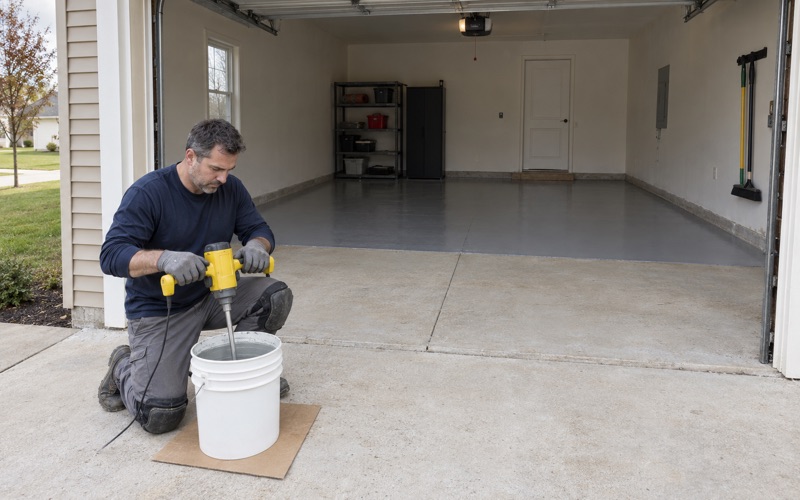
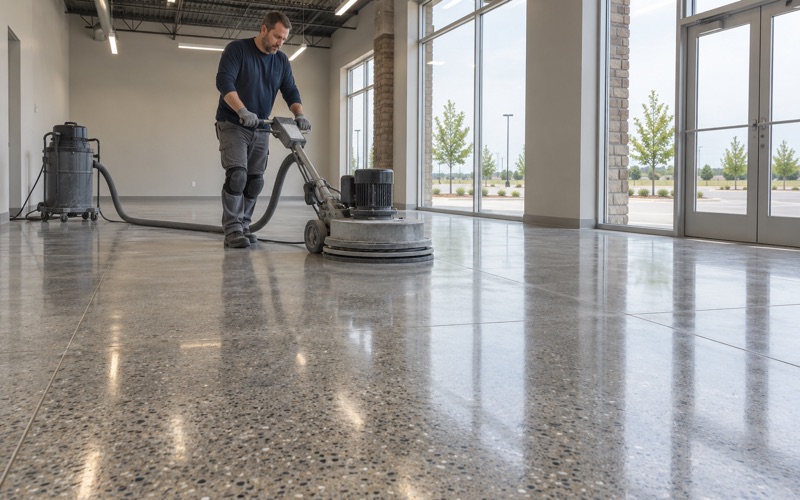
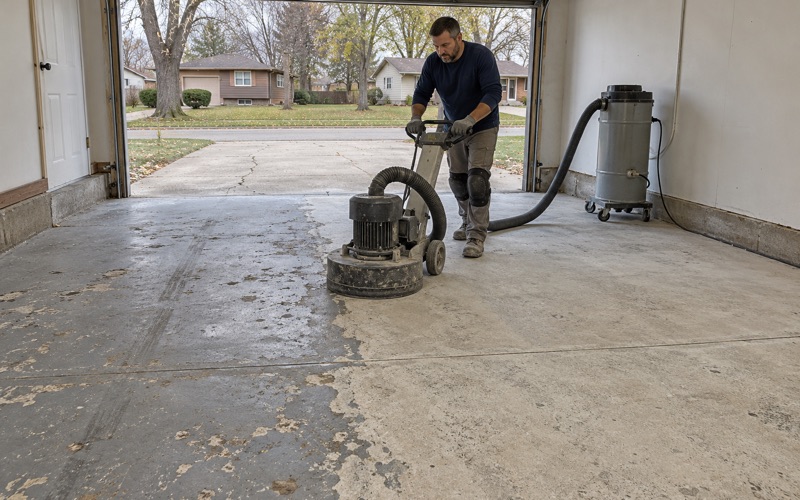
Every job begins the same way regardless of size. We open the concrete with a diamond grinder or a shot blaster rather than an acid etch, test it for moisture before the price is final, and write a proposal that names the product line, the coat count and the finished thickness so the floor can be checked against it later.
Certified Industrial Sites and What Gets Built on Them
Five sites, more than any other Iowa town
Bondurant holds five sites certified through the Iowa Economic Development Authority program, overseen by Quest Site Solutions, and IEDA reported in June 2025 that no other Iowa community has more. Certification covers environmental and archaeological reviews, utility assessments and mitigation planning, so a buyer starts with fewer unknowns about the ground.
The first site, certified in 2019, was quickly secured by Amazon for its central Iowa fulfillment center. Amazon announced that building as a 645,000-square-foot site where employees would work alongside Amazon robotics to pick, pack and ship small items. We have no relationship with Amazon or with any certified-site owner; the point is what that scale tells a tenant about the buildings going up around it.
That record matters to a floor contractor for a simple reason: certified ground is ready-to-build ground. Each new shell is another bare slab that will need a decision about coatings, a lithium silicate densifier or nothing at all before the first pallet arrives.
Light industrial on the newest ground
The newest addition is the Ross Certified Site, nearly 83 acres northeast of the Des Moines metro and zoned for light industrial use, near I-80, I-35 and U.S. Highway 65. The Myers Industrial Site east of Hubbell Avenue was certified in 2022, and two more followed in 2024, including the 188-acre Timmins Industrial Park.
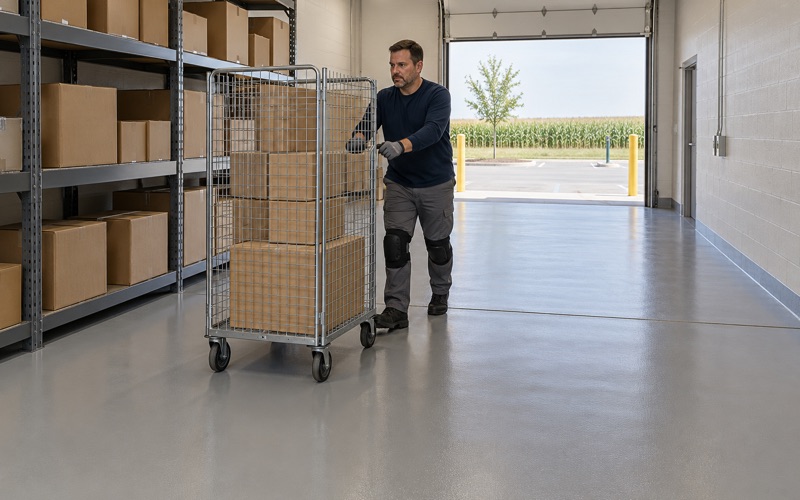
Light-industrial tenants rarely need one floor finish wall to wall. A shipping area, an assembly line and a battery room each ask different things of the concrete, and a fit-out scope that treats them as one usually overpays in one place and underbuilds in another.
Fit-out is when the floor gets decided
A certified site settles questions about the ground, but the building on it usually arrives with a plain troweled slab. The tenant decides what goes on top, and that decision tends to happen in the same weeks that racking, power drops and charger locations are being finalized.
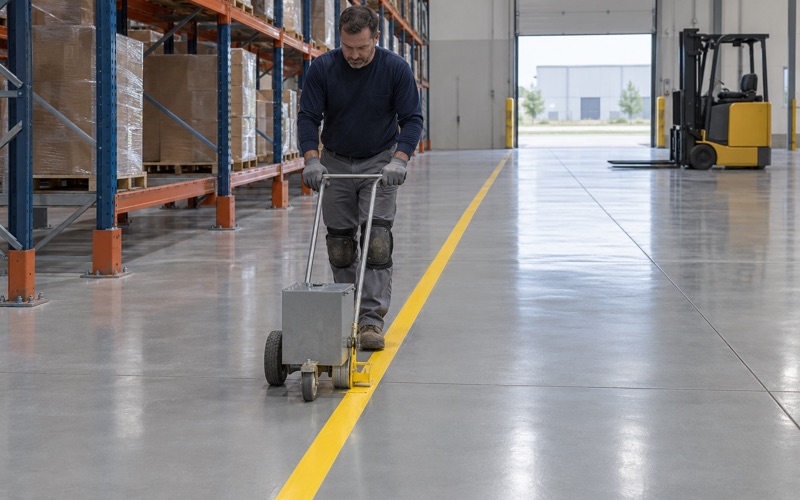
We ask for the floor plan early and mark three things on it: where trucks will charge, where people will walk, and where wet cleaning will happen. Those three lines decide which areas need a chemical-resistant system, which need a slip-resistant texture, and which can stay as densified bare concrete.
Looking for epoxy-flooring closer to Altoona? See Epoxy-Flooring Services in Altoona.
Forklift Battery Charging Under OSHA 1910.178(g)
What the federal rule actually names
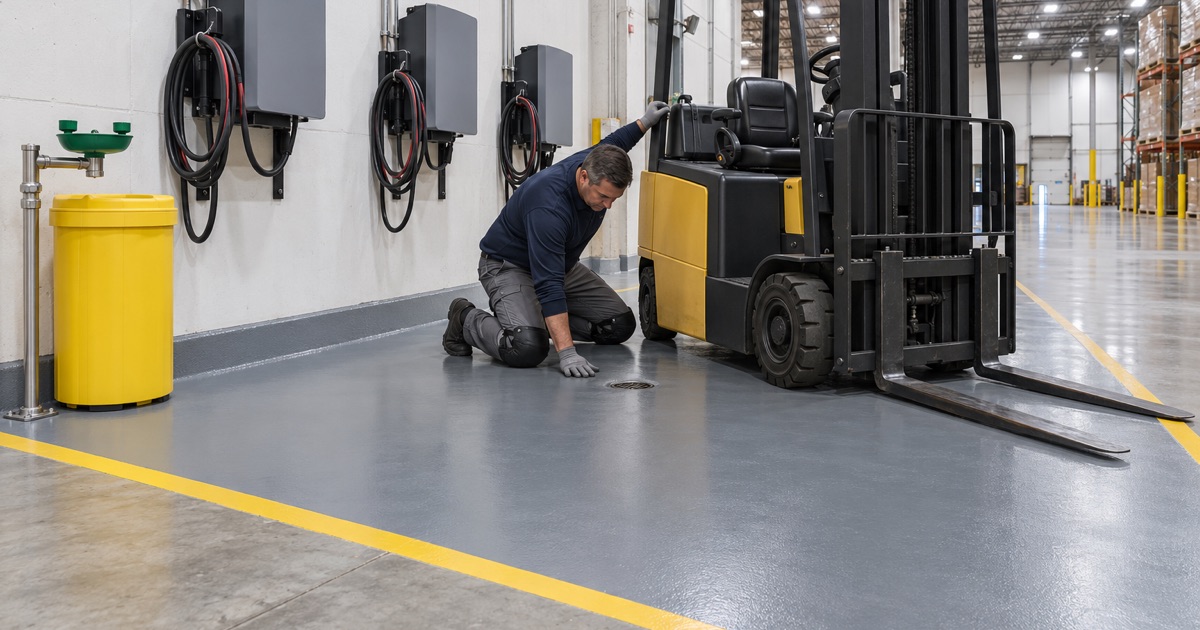
Federal OSHA 29 CFR 1910.178(g)(1) says battery charging installations shall be located in areas designated for that purpose. Paragraph (g)(2) then requires facilities for flushing and neutralizing spilled electrolyte, for fire protection, for protecting charging apparatus from damage by trucks, and for adequate ventilation to disperse fumes from gassing batteries.
The rule goes further on handling. It calls for a carboy tilter or siphon for electrolyte, and it states that acid shall be poured into water, never water into acid. Iowa runs a state OSHA plan, and we have not confirmed how it adopts this section, so a tenant’s safety lead should check the current state text.
What a chemical-resistant coating does
Notice what the rule does not say: no floor coating requirement appears in it. A coating is one way an owner makes a designated charging area easier to wash down after a spill, because sulfuric acid electrolyte attacks bare concrete paste and leaves it pitted and dusty.
Not every epoxy holds up to battery acid. Standard garage-grade epoxy can soften or stain under repeated sulfuric acid contact, so for a charging area we specify a chemical-resistant line rated for that exposure and name it in the proposal along with the coat count and thickness.
A chemical-resistant epoxy system, built with the right primer and topcoat for acid exposure, gives the flushing water a surface it can run across instead of soaking into. Spills stay visible, cleanup is faster, and the slab under the bay does not slowly erode where batteries are watered.
What it does not do
A coated floor is not compliance by itself. The flushing and neutralizing facilities the rule names still have to be provided in whatever form the tenant’s safety plan specifies, and fire protection and ventilation are separate obligations entirely.
We say this plainly in the proposal. If someone pitches a coating as the thing that satisfies the charging-area rule, they are selling something the rule never asked for. Our job is the floor, and we scope it to support the equipment a tenant’s safety plan already calls for.
We also stay out of the electrolyte handling itself. The carboy tilter or siphon, the neutralizing agent and the training around them belong to the tenant’s safety program, and our floor only has to make cleanup after a spill quicker and more complete.
Sizing the Charging Bay and Its Wash-Down Edge
Drawing the coated footprint
We size the chemical-resistant zone from the charger layout, not from a round number. That means the full footprint where trucks park to charge, the path where batteries are swapped or watered, and enough margin that a drip from a moving truck lands on coated concrete rather than bare slab.
The rule also wants charging apparatus protected from damage by trucks. Bollards and curbs are anchored into the slab, so we coordinate with whoever sets them: anchoring after the coating cures means drilling through a finished floor, while setting them first lets us coat tight around the bases.
Where a tenant expects the layout to grow, we often suggest coating the planned expansion now. Grinding and coating an empty bay costs far less than working around live chargers and parked trucks two years later.
The edge where wash water stops
The boundary of a charging bay matters as much as its middle. We look at slope, joints and where flushing water will travel, and we can build a thicker termination or a cove at walls so water and neutralized electrolyte do not wick under the coating edge.
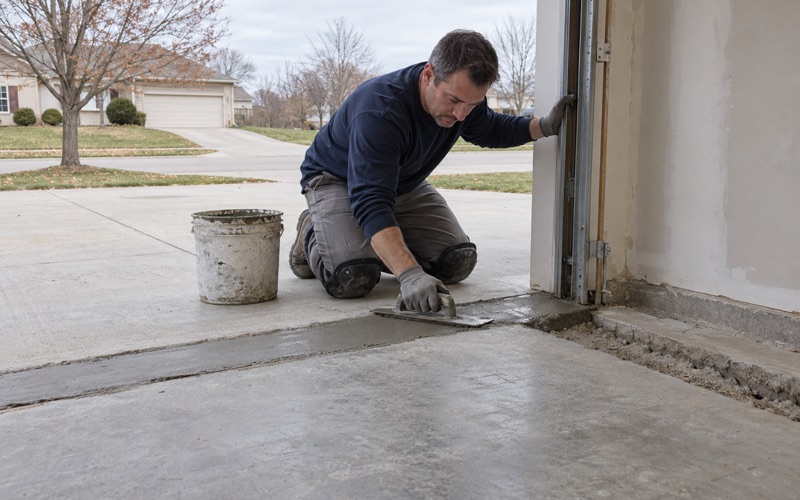
Cracks and joints inside the bay are mapped before anything is quoted. If a section is too damaged to hold a coating, we say it needs repair first. A slip-resistant texture is specified by the aggregate broadcast and topcoat we name, because a smooth floor under a wet wash-down is its own hazard.
Phasing the work around shifts
Many Bondurant tenants are operating before every bay is finished. We phase charging-area work around shifts, with overnight and weekend windows when a line cannot stop, and we cure by slab temperature and dew point rather than by the calendar.
Dock doors on a busy building cycle all day during fit-out. We read the dew point spread at the slab surface before each coat, because a cold slab under humid air collects condensation that leaves amine blush on epoxy and weakens the bond to the next layer.
Grinding dust is captured at the machine with a vacuum instead of being rinsed toward a trench drain or a storm inlet. On a new industrial lot that keeps the site clean and keeps concrete fines out of the stormwater system.
Owner Garages on Bondurant’s Young Subdivisions
Newer houses get the same test
Bondurant’s residential side grew just as fast. The 2020 census counted 7,365 residents, up 90.8 percent from 2010, and Census estimates show 52.8 percent of homes built in 2010 or later, with roughly nine in ten occupied by their owners.
Most Bondurant homes are detached houses, which means most garage floors here are a homeowner’s own decision rather than an association’s or a landlord’s. That makes the written scope the owner’s protection, and ours tells them plainly when cracks or spalls mean a repair comes before any coating.
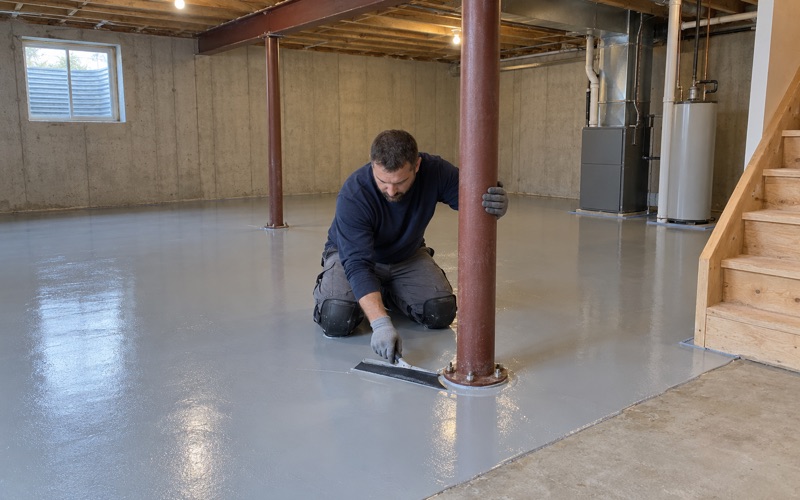
A young house is not a safer garage in our book. We moisture test the slab whatever year it was poured, and we check for any earlier sealer before choosing a system. A coating also never stops water entering a garage or basement, so we do not sell it as protection from the heavy summer rains this part of Polk County sees.
Built for central Iowa winters
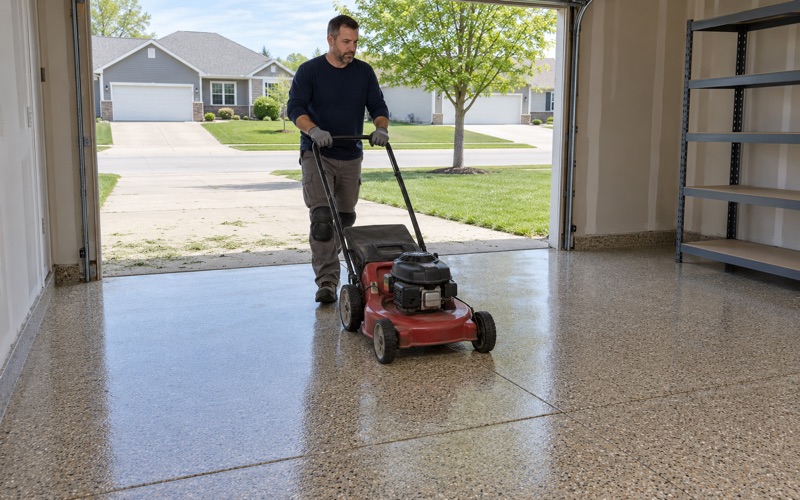
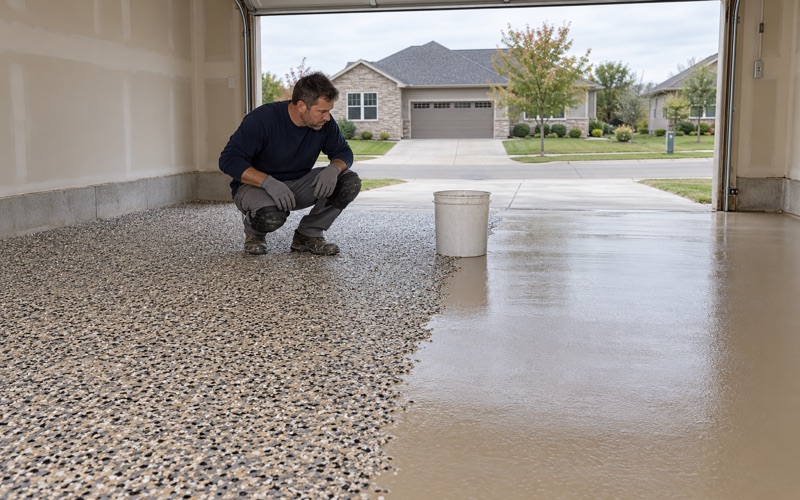
From November through March, brine and rock salt ride in on tires and sit on the floor for weeks. We choose garage systems for that exposure, typically a 100% solids epoxy base with a polyaspartic topcoat and a vinyl flake broadcast that hides grit and adds grip.
Salt also works on bare concrete, which is why freeze-thaw scaling shows up on uncoated garage slabs near the door after a few winters. A sealed, coated surface keeps brine from soaking in, and a squeegee and a rinse in spring take care of what is left.
Hot tire pickup is the other garage failure we plan around. A thin roll-on kit can lift where warm tires sit after a drive, while a ground slab with a full-build base coat and a polyaspartic or polyurea topcoat gives the tires nothing loose to pull.
An unheated garage in January is told to wait for workable slab temperatures. Low-odor products are available for attached garages as a comfort choice, and before any job is sold we explain what the warranty excludes, with moisture named first.
- 20+ Years on Concrete
- Moisture Tested Before Pricing
- Ground, Never Acid Etched