Ankeny Epoxy Flooring has spent more than 20 years on epoxy flooring in Boone and across central Iowa, and the floors we think hardest about here are the ones that have already lived one life. A slab that spent years under a freezer is not a blank slate. It carries a buried assembly and, sometimes, a record of movement that a coating will not erase.
Every job we take starts the same way, with the slab mapped before anyone talks about color. We chart cracks, spalls and old coatings, run a moisture test that is written into the scope before the price is final, and tell an owner plainly when a floor needs repair or replacement first. That habit matters more on a converted cold room than anywhere else.
This page covers what a freezer floor is built from, how frost heave shows itself, and how we approach resurfacing one for a new use. It also covers the older houses and mixed soils that shape our garage and basement work in town.
Fareway’s New Freezer and the Old One Turned Dry Storage
What the Expansion Adds
Fareway broke ground in March 2026 on a 105,000-square-foot freezer expansion at its Boone distribution campus. The company’s release says the project nearly doubles pallet capacity, increases pallet facings by 33 percent and adds dock space. Gleeson Constructors and Engineers is the contractor, and the work is set to finish by summer 2027.
We have no part in that project and no relationship with Fareway or Gleeson. We mention it because cold storage is the distribution-scale floor story in Boone right now, and because the wholesale campus here is a real employer: in 2023 the city’s mayor said more than 600 employees continue to work at the campus and office in Boone.
Dual Temperature, Two Kinds of Floor
The release also describes dual temperature environments on the campus. In flooring terms, dual temperature generally means two different jobs: a freezer floor built with insulation and usually heat beneath it, and a dry storage floor that mostly has to carry pallets, racking and wheels without dusting or wearing through.
The two floors also age differently. A dry storage slab is judged on flatness, abrasion and how cleanly it can be swept, while a freezer slab is judged first on whether the ground below it is staying put. When one becomes the other, both sets of questions apply at once.
Why the Old Freezer Is the Floor to Watch
The same release says Fareway’s current freezer space will be repurposed into additional dry storage. That detail is the one a flooring contractor notices. Any room that ran below freezing for years and then warms to ambient temperature becomes a different floor, even if nobody pours a yard of concrete.
Fareway has not published its floor temperatures, slab design or any heave history, and we would not guess at them. What we can describe is how freezer floors are generally built and how they generally fail, because that is exactly what anyone converting a cold room in Boone, large or small, should understand before choosing a coating.
Looking for epoxy-flooring closer to Perry? See Epoxy-Flooring in Perry.
What Sits Under a Freezer Floor and How Frost Heave Shows
The Insulated Assembly
A freezer floor is a built assembly, not just a slab. Under the concrete there is usually moisture-impermeable insulation rated for below-grade use, a poly vapor barrier and, typically, an underfloor heating system. Plant Services, writing on cold storage in January 2022, noted that one inch of that insulation is thermally equivalent to about two feet of soil.
The heat is the part people forget. Insulation slows the cold, but over years a room held below freezing can still pull the ground beneath it down past 32 degrees. The underfloor heat exists to keep that subgrade above freezing, and when it fails or was never installed, the soil starts to change.
Ice Lenses and Enormous Pressure
Frost heave happens when saturated subgrade soil drops below freezing. Water in the soil gathers into ice lenses, and in the Plant Services description those lenses push upward with enormous pressure. Concrete is strong in compression but has little answer to a force lifting it from below in uneven patches.
This is cold that comes from the room itself. A freezer can heave its own floor in the middle of summer, and the damage keeps building as long as the room stays cold and the ground stays wet. Heave is a slow story told over years, which is why a floor can look fine at a glance and still be moving.
Cracks, Bulges and Racks Out of Plumb
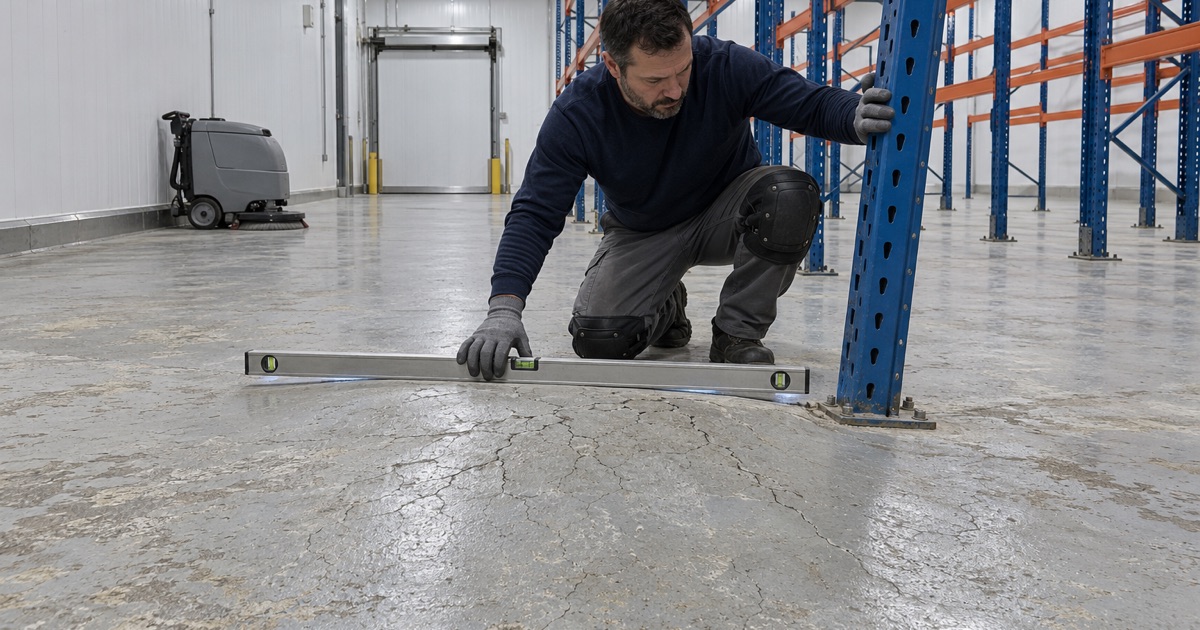
The first signs are modest: small cracks and low bulges in the concrete that are easy to blame on age. Next the floor grade goes uneven, pallets sit poorly, and forklift travel gets rougher across certain lanes. Later still, racks tilt out of plumb and doors that used to swing freely start to bind or stop closing.
Repair is not a weekend fix. The room is shut down so the ice can thaw and the floor can settle, and Plant Services notes that this can take several weeks in some cases. A floor coating does nothing to stop frost heave, and no coating can hold a slab down once ice is lifting it.
Resurfacing a Slab That Used to Be a Freezer
Survey the History First
When a former freezer is headed for dry storage, we survey the slab for its heave history before we price a coating. We walk the floor with a straightedge and look for the pattern heave leaves: cracks that cluster rather than wander, bulges where the grade rises, and joints that have opened or stepped. We also ask what happened to the underfloor heat and whether the room was ever shut down for repair.
A floor that heaved and then settled may be serviceable for racking and forklifts, or it may need grinding, patching or partial replacement before any coating goes down. We say which it is in writing. Coating over a slab that is still out of level only locks in the problem under a glossier surface.
The same survey applies to smaller conversions around Boone, such as a walk-in freezer pulled out of a shop or a cold room turned into a storeroom. The scale is different, but the questions about insulation, the possibility of old heave and the need to check level before coating are the same.
Moisture After the Cold Is Gone
A slab that spent years cold has likely never been moisture tested at room temperature, and conditions in the concrete can shift once it warms. That is why the moisture test stays in our written scope even on a commercial floor that looks bone dry. We use ASTM F2170 in-situ relative humidity probes or ASTM F1869 calcium chloride testing, depending on the slab and the product, and the result is in hand before the price is final.
If the readings come back high, a moisture-mitigation primer may become part of the system. Before anything is sold, we explain what the coating warranty leaves out, and moisture vapor transmission is the first exclusion we name. A dry storage floor is also a forklift floor, so a moisture question never gets settled by hope.
Grinding and a System for the New Use
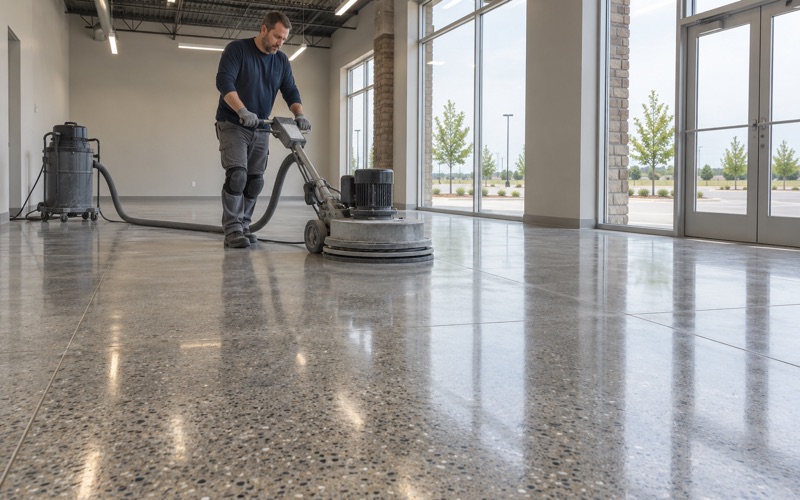
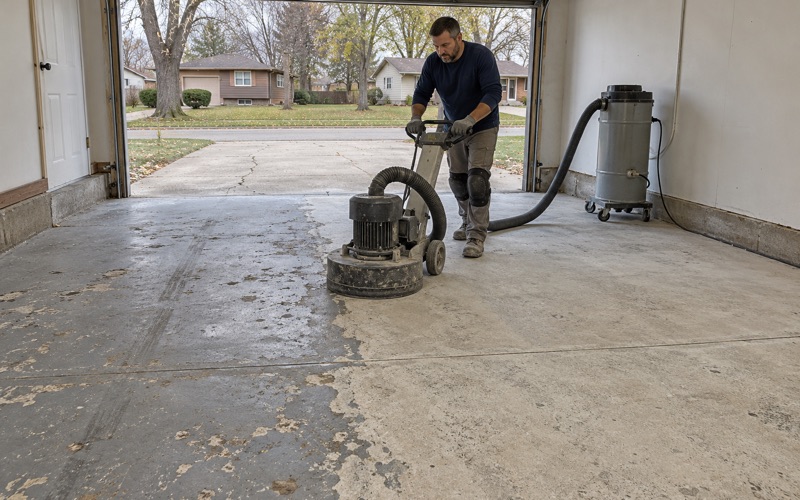
Old freezer floors can carry sealers, paint lines or worn coatings. We open the surface with a diamond grinder or a shot blaster, never an acid etch, to reach a real concrete surface profile on the ICRI CSP scale. Dust is captured at the machine by vacuum rather than washed toward a floor drain.
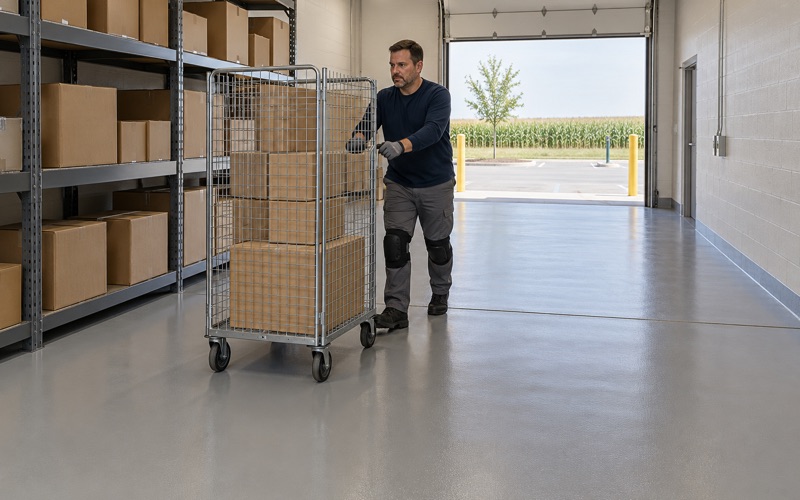
For dry storage under forklift traffic, we typically look at 100% solids epoxy with a quartz aggregate broadcast, or urethane cement where a floor still sees cold or washdown. The proposal names the product line, the number of coats and the finished thickness, so the owner can check the floor against the quote. Work is phased around shifts, with overnight and weekend windows when a warehouse cannot stop.
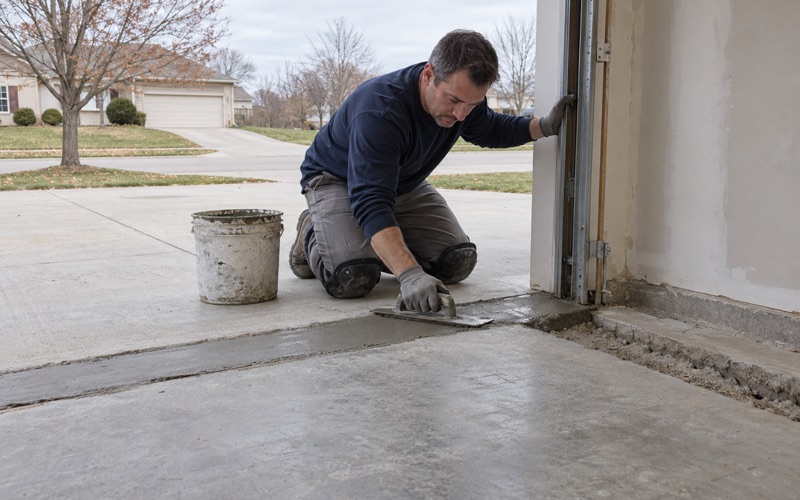
Joints and repaired cracks get their own plan. A crack that moved during heave and has since stopped can be filled and ground flush, while one that is still opening is flagged and left for the owner to address before we coat over it. Either way, the map we made at the start shows where each one sits.
Boone’s Prewar Houses on Till and Swale Soils
An Older, Owner-Held Housing Stock
Garage and basement floors in Boone are a different job from a cold room. Boone is the county seat of Boone County, and its housing skews old: 39.3 percent of units were built in 1939 or earlier, 70.6 percent are detached houses, and 71.6 percent are owner-occupied. Many of those slabs were poured long before under-slab vapor retarders were routine.
Age is not the whole story, though, and a newer house does not get a pass. We test the slab whatever year the house went up. In a basement we read for past water first, checking the sump pit and drain tile where they exist, because a coating does not stop seepage and is never a substitute for drainage.
Clarion on the Rises, Canisteo in the Swales
Boone sits on Des Moines Lobe till, and the soil survey shows how much that varies across a short distance. Well-drained Clarion loams cover the rises, while poorly drained Canisteo and Coland-Spillville soils fill the swales, where the mapped water table reaches the surface. Two slabs in the same town can sit over very different moisture.
A swale lot is where a moisture test earns its keep and where a mitigation primer is most likely to enter the conversation. A floor coating is never waterproofing, radon mitigation or flood protection. In Iowa, radon testing and mitigation take a state credential, so we do not sell a coating as radon work.
Garages, Cure Timing and the Code
Garage floors here face brine and rock salt riding in on tires from November through March, so we choose systems built for that, often with polyaspartic topcoats over a vinyl flake broadcast. Slip resistance comes from the broadcast and topcoat we specify, not from a promise. Low-odor products are available for attached garages as a comfort choice, never as a legal requirement.
On older detached garages, the slab can be thin, patched or worn, and we map that damage before anything else. Hot tire pickup is a common failure on cheap garage kits, which is one reason we grind rather than etch and build the system to a stated thickness.
Cure schedules follow slab temperature and dew point rather than the calendar, and an unheated garage in winter is told to wait. Boone’s code of ordinances adopts the 2012 International Building Code and International Residential Code with local amendments, and the published code library is current only through 2019. We confirm the current edition with the City of Boone building official before relying on any section.
- 20+ Years on Concrete
- Moisture Tested Before Pricing
- Ground, Never Acid Etched