
Ankeny Epoxy Flooring provides concrete grinding and shot blasting in Ankeny, IA, serving surrounding cities including Saylorville, Johnston, Polk City, Bondurant and Altoona. Grinding is the step that decides whether a floor coating stays bonded, and after 20+ years of preparing central Iowa slabs we treat it as the most important part of every job.
Every concrete slab has a thin, weak skin on top called laitance, plus whatever sealers, paint, oil and dirt it has collected. A coating applied over that surface is only as strong as the skin, which is why so many retail-kit and acid-etched floors peel. Grinding cuts through it to clean, sound concrete with an open texture the coating can lock into.
We grind every slab we coat, and we also grind floors for customers who need an old coating removed, a trip hazard taken down or a slab prepared for another flooring product.
Diamond Grinding and Shot Blasting
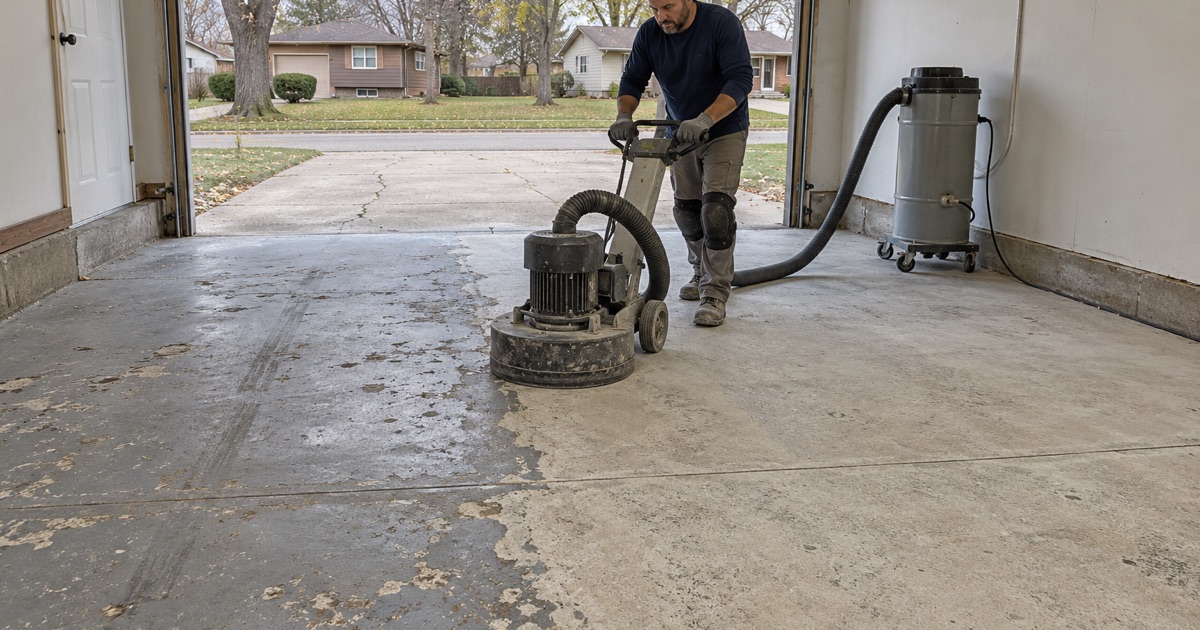
Diamond Grinding
Diamond grinding uses rotating heads fitted with metal-bond diamond segments to cut into the surface of the slab. It is precise, works right up to walls and edges with smaller machines, and can be adjusted from a light scuff to an aggressive cut that removes thick coatings.
It is our usual method for garages, basements and most commercial floors. Grinding also flattens minor ridges and trowel marks, which matters under a glossy metallic or a polished finish where every bump shows.
Shot Blasting
Shot blasting fires small steel shot at the concrete, which chips away the surface and leaves a uniform, textured profile. The shot is recovered and reused by the machine, and the dust is pulled into a vacuum.
Shot blasting covers large open areas quickly, which makes it a good choice for warehouses and industrial floors. It leaves a rougher profile than most grinding, suited to thicker coatings like urethane cement and high-build epoxy.
Concrete Surface Profiles
What the ICRI CSP Scale Means
The International Concrete Repair Institute publishes a concrete surface profile scale that runs from CSP 1, nearly flat, to CSP 10, very rough. Coating manufacturers name the profile their product needs, and the industry uses physical chips cast to each profile as a reference.
We compare the prepared floor with those reference chips before coating. That turns surface prep into something we can check and record, rather than a vague promise that the floor was roughed up.
Matching the Profile to the Coating
Thin coatings and sealers need a light profile, because a rough surface would show through them. Standard epoxy garage and basement systems need a moderate profile, and thick urethane cement or trowel-applied systems need a deeper one to anchor their weight.
Grinding to the wrong profile causes problems either way. Too smooth and the coating has nothing to grip, and too rough and a thin system can show the texture or leave pinholes. The proposal names the profile we will grind to for your system.
Removing Old Coatings, Adhesives and Contamination
Paint, Sealers and Failed Coatings
Peeling paint, worn sealers and failed epoxy all have to come off before a new floor can go down. We grind through them to sound concrete, because a new coating applied over an old one inherits every weakness of the layer underneath.
Sometimes an old coating is still well bonded in places. We test the bond and tell you whether any of it can stay, but in most cases a full removal is the only way to stand behind the new floor.
Tile Adhesive and Mastic
Old vinyl tile often leaves black mastic on the slab. Some older cutback adhesives contain asbestos, so we ask about the age and history of the floor and arrange testing before grinding when there is any doubt.
Once cleared, mastic is ground off down to clean concrete. Leaving adhesive residue under a coating causes soft spots and bond failure, and it can bleed through the finish as dark stains over time.
Oil and Grease
Garage and shop floors often carry oil that has soaked into the concrete. Surface oil is degreased and most of it comes off in the grind, but deep contamination can keep wicking up and stop a coating from bonding.
We identify oil-soaked areas during the walk-through. Some can be cleaned and treated, while badly contaminated spots may need to be cut out and patched before the floor can be coated.
Grinding for Polished Concrete and Other Flooring
The First Cut on a Polished Floor
On a polished concrete job, the first grind is not just preparation, it is a design decision. How deep the metal-bond diamonds cut sets how much of the slab’s sand and stone the finished floor shows, from a cream finish that stays in the top paste to a full exposure of the larger aggregate.
We grind a test area first so you can see what your slab holds before committing the whole floor. The rest of the sequence, from coarse metal-bond to fine resin-bond diamonds, then builds on that first cut until the surface takes a polish.
Preparing a Slab for Another Trade
Not every floor we grind gets our coating. Tile setters, flooring installers and builders sometimes need a slab cleared of old adhesive, paint or a failed sealer, or flattened at the joints before their own product goes down.
We grind to the profile and flatness the next product calls for and leave the floor vacuumed and ready. Telling us what will be installed on top is the most useful thing you can do, because a profile that suits a thick resin can be too rough for a thin-set or a self-leveling underlayment.
Dust and Slurry Control
Grinding dust is captured at the machine by a vacuum connected to every grinder and shot blaster, rather than swept up afterward or rinsed away. That keeps the air in an attached garage, basement or occupied building cleaner, and it keeps the floor clean for coating.
We never wash grinding dust or slurry toward a floor drain or a storm inlet. Concrete fines and old coating residue do not belong in a sewer or in the creeks that storm drains feed, so the waste is collected and bagged on site.
- 20+ Years on Concrete
- Moisture Tested Before Pricing
- Ground, Never Acid Etched