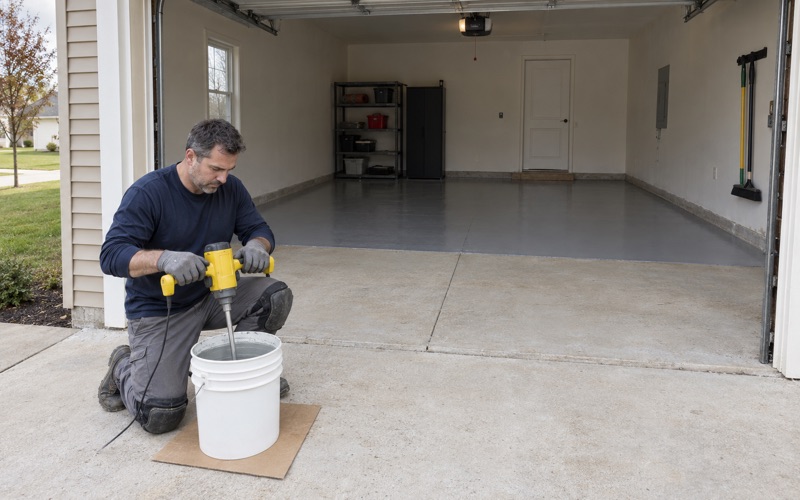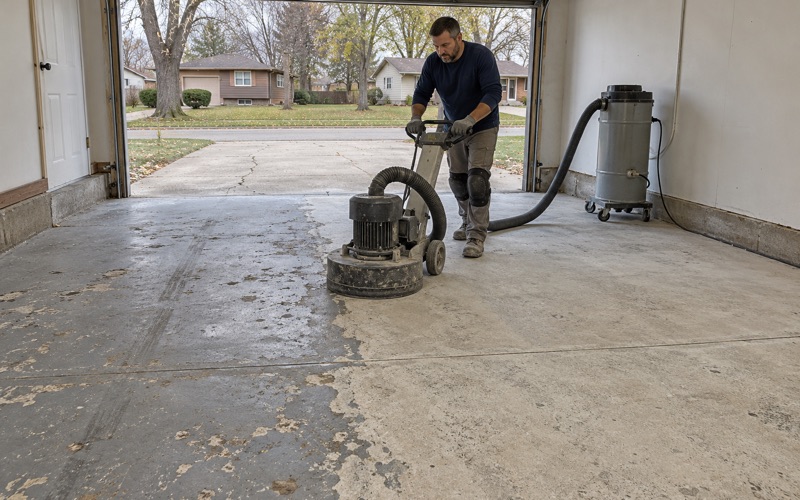
Ankeny Epoxy Flooring has spent more than 20 years on epoxy-flooring in Huxley and across central Iowa, and the floors we think hardest about here are the ones an older owner crosses every day. Our work starts with the slab, not the color chart. Every floor is opened with a diamond grinder or a shot blaster rather than an acid etch, so the coating has a real profile to bond to.
A good-looking floor and a safe-feeling floor are not always the same floor. A high-gloss finish under bright garage lights can throw glare back at the eye, and a busy flake blend can blur the edge of the step into the house. We talk through sheen, color and edge contrast during the estimate, alongside the moisture test that is written into every scope before a price is final.
None of this is a promise about falls. No coating can make that promise honestly, and we do not sell one that way. What a floor can do is stop working against the person walking on it, and that is the job we plan for.
Anthem’s 55-Plus Homes on Highway 69
What Anthem is adding at the south edge of town
In February 2025, Business Record reported that construction would begin that spring on Anthem, a 120-acre mixed-use development on the west side of Highway 69 at Huxley’s southern edge. The plan includes an 18-unit for-sale condo project, a 55-plus townhome community with units for sale and for rent, and two 45-unit senior apartment complexes. The same report put Huxley at about 4,800 residents, a gain of nearly 30 percent over the past decade.
We have no part in that project and know nothing about how its garages or floors were specified. What we do know is who those homes are built for. A household that chooses a 55-plus community or a senior condo is planning for the years ahead, and the floor in the garage belongs in that planning as much as the grab bar in the bathroom.
When the garage is the front door
For many older owners, the front door is for visitors. The everyday way in is the garage: park, step out of the car, cross the slab with groceries or a cane, and climb the step into the kitchen or mudroom. That route gets walked several times a day, often in the low light of early morning or evening.
The CDC says more than one out of four older people falls each year, and less than half tell their doctor. Those are national figures, not Huxley’s, but they explain why we treat a garage floor for an older household as a walking surface first and a showpiece second. The decisions that matter most are the ones a homeowner sees every time they come home: sheen, color and the edge of the step.
Newer homes still get a tested slab
Huxley’s housing is young. Census figures show about half of the city’s homes were built in 2000 or later, and 80.7 percent of occupied homes are owner-occupied. A new townhome or a 2010s house can feel like a safe bet for a coating, but we test the slab whatever year it was poured.
The ground around town is glacial till on the Bemis moraine, where well-drained Clarion loam knobs sit beside poorly drained Webster swales with a seasonal water table close to the surface. A slab on one lot can behave differently from a slab two streets over. A calcium chloride test under ASTM F1869 or in-situ relative humidity probes under ASTM F2170 tell us which one we have.
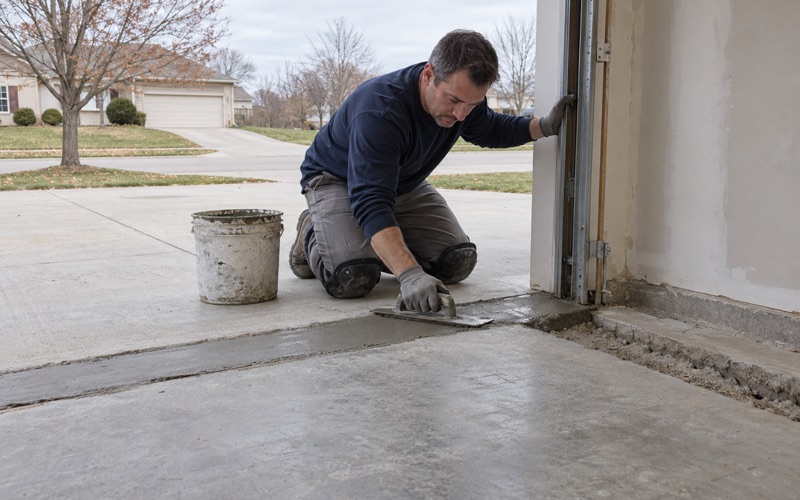
The same visit maps cracks, spalls and old coatings across the slab. If a garage floor or basement slab needs repair or replacement before it should be coated, we say so plainly, even when that means the coating waits.
Looking for epoxy-flooring closer to Clive? See Clive Epoxy-Flooring.
Glare and Sheen: Why Mirror Gloss Works Against Older Eyes
What the CDC checklist says about glare
The CDC’s home fall prevention checklist for older adults is plain about vision. It says poor vision can increase the risk of falling, and it recommends lightweight curtains or shades to reduce glare. The checklist was written with windows in mind, but the same principle reaches the floor.
A high-gloss topcoat is close to a mirror. Under a row of bright garage fixtures or a low winter sun through an open door, it bounces light straight back up, and a bright patch on the floor can hide what is actually there. For eyes that already struggle with contrast, that reflection is one more thing to read through on the way to the door.
Satin and matte topcoats
Most coating systems we install can be finished in more than one sheen. For an older household we usually steer toward a satin or matte topcoat, which softens reflections without making the floor look dull or unfinished. We put samples down under the owner’s own garage lights before anyone signs, because a chip in a showroom tells you very little.
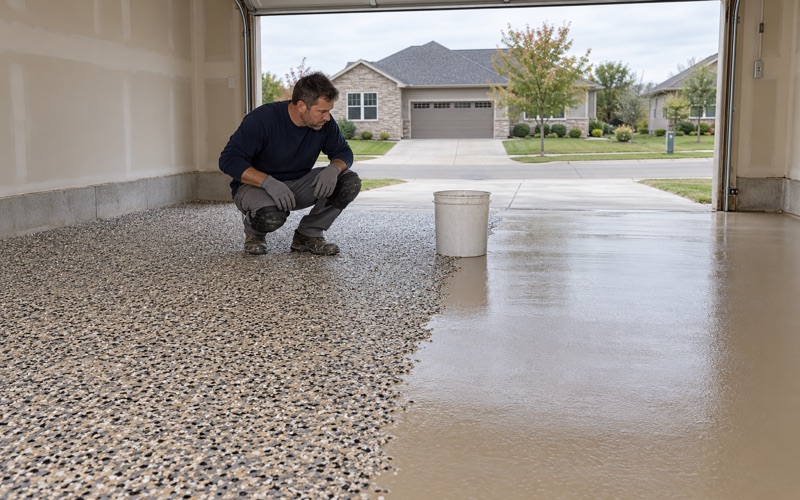
Sheen is a topcoat decision, so it sits on top of the same build we would use anyway: a ground profile, a 100% solids epoxy or similar base, a vinyl flake broadcast if the owner wants one, and a polyaspartic or urethane topcoat. Our proposal names the product line, the number of coats and the finished thickness, and it names the sheen too, so the floor can be checked against the paper.
Lighting and the floor work together
The checklist also calls for an overhead light and switches at the top and bottom of stairs. We do not do electrical work, but we will point out a dim garage or a switch on the wrong side of the room during the estimate. A low-sheen floor under good, even light is easier to read than either one alone.
Seeing the Step: Color, Flake and a Contrasting Edge Band
Choosing a field color that does not hide the step
When a coating is carried up and over the step from the garage into the house, the field color decides how visible that edge stays. If the floor, the riser and the landing all share one busy flake blend, the edge disappears, and the step reads as one flat surface until a foot finds it.
For these garages we lean toward a calmer field: a solid color, or a flake blend with fewer contrasting chips and a tighter range of tones. Medium grays and tans tend to work well because a light or dark edge band shows up clearly against them. Very dark floors swallow shadows, and very busy ones camouflage everything on them, including a dropped key or a step edge.
A contrasting edge band at every step
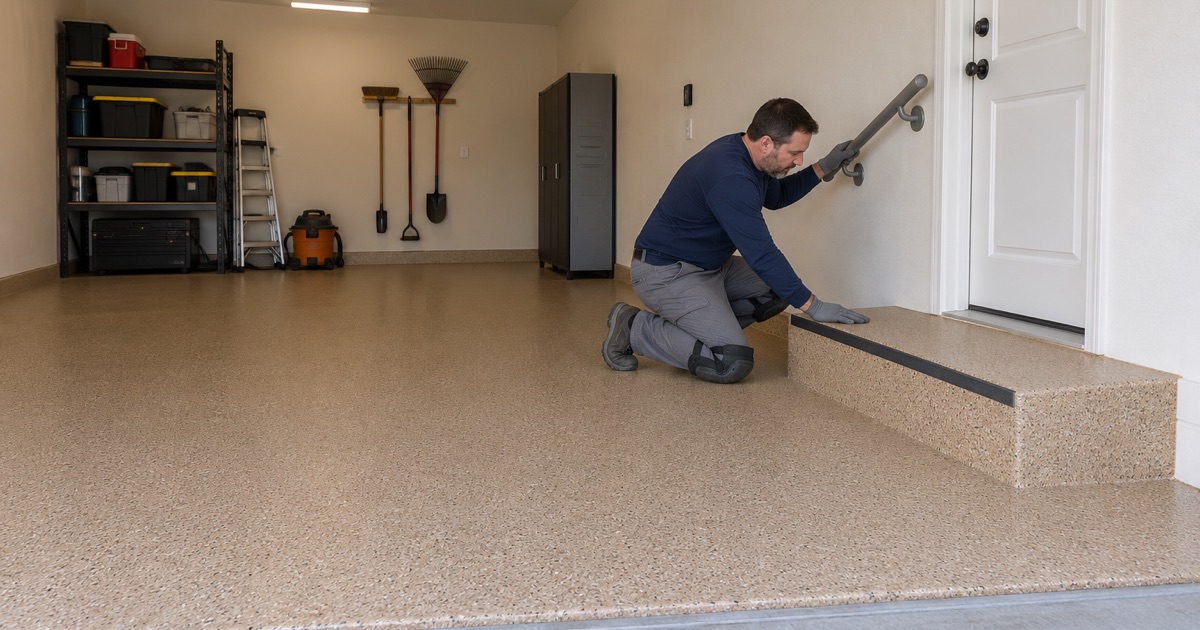
The CDC checklist is specific here. It says to paint a contrasting color on the top edge of all steps so you can see the stairs better, with the example of light paint on dark wood. On a coated floor we build that same idea into the system as a band of contrasting color along the nose of each step, set in the base coat and sealed under the topcoat.
Because the band sits under the same topcoat as the rest of the floor, it wears with the floor instead of peeling off like a strip of tape. We match its width to the step and keep the line crisp, and the owner picks the color from samples laid against the field color they chose. We do not present the band as meeting any code; it is there so the step can be seen.
Texture without losing the line
Some owners also want grip on the step itself. That comes from the broadcast and topcoat we specify, such as a fine quartz aggregate in the final coat, not from a slogan. We keep any added texture fine enough that the edge band still reads cleanly and the surface stays easy to sweep.
Basement Stairs, Landings and the Slab Underneath
Landings at the bottom of the stairs
The CDC checklist covers steps both inside and outside the home, and a basement stair that ends on bare concrete is part of that. When we coat a basement floor in Huxley, the landing at the foot of the stairs gets the same treatment as the garage step: a low-sheen topcoat and a contrasting band where the last tread meets the slab.
Where the stair itself is wood or carpet, we leave it alone and finish the band on the concrete at its base so the transition is easy to see. The checklist also says to wear shoes both inside and outside the house, which is worth repeating to anyone who plans to walk a coated basement floor in socks.
Reading the basement for water first
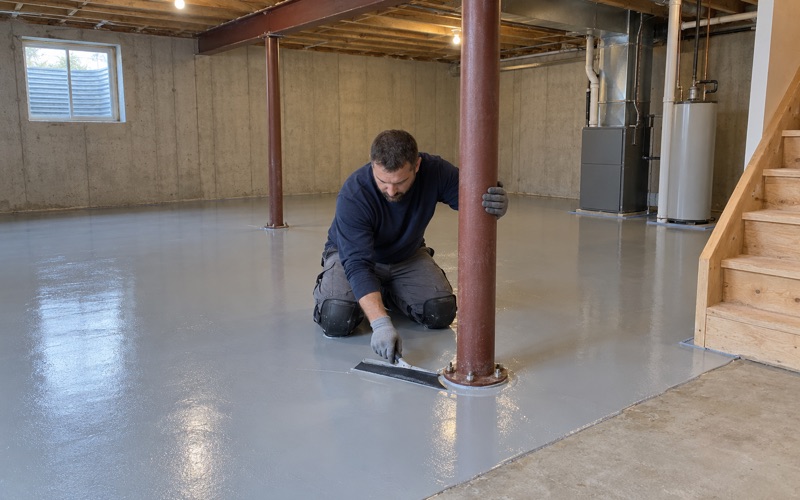
A basement floor is read for past water before we talk about color. We look at the sump pit and the drain tile, check the walls and floor for efflorescence, and ask about any wet spring the owner remembers. A coating does not stop seepage, and a floor that sees water from below is a floor we would rather leave uncoated than coat badly.
That check matters most on the poorly drained Webster ground in town. Moisture is also the first exclusion we name when we explain what a coating warranty leaves out, and we explain it before the job is sold. If the readings call for a moisture-mitigation primer, the proposal says so before anyone commits.
Odor, cure and getting back in the house
For an attached garage or a finished basement, we offer low-odor products as a comfort choice for people who will be living right beside the work. That is a preference we can meet, not a rule Iowa imposes. We also plan the cure around slab temperature and dew point rather than the calendar, and in a central Iowa winter an unheated garage is told to wait.
For an older owner whose garage is the only practical way in, the schedule matters as much as the finish. We set out how many days the garage will be off limits, when it can take foot traffic and when the car can come back, so nobody has to improvise a route through the front yard.
- 20+ Years on Concrete
- Moisture Tested Before Pricing
- Ground, Never Acid Etched