Ankeny Epoxy Flooring brings more than 20 years of epoxy-flooring work to Nevada, Iowa, and most of the floors we look at here start with one question. Was this slab ever reviewed by anyone before it was poured? For a garage in town or a new building on zoned rural land there is usually a permit on file somewhere, but a working farm building may have none at all.
That gap shapes how we scope a job. We open every slab with a diamond grinder or a shot blaster rather than an acid etch, and we put a moisture test into the written scope before the price is settled. Neither step depends on paperwork, which is exactly why they matter on a floor nobody has documented.
This page walks through what the county seat’s permit system covers, what Iowa law takes out of it, and how we read a machine shed or farm shop floor on site before any coating goes down. The goal is a floor that holds, not a promise built on records that may not exist.
The County Seat and Its Zoning Permit

What Story County Asks For
Nevada is the Story County seat, and the county’s Planning and Development office works out of the Administration Building at 900 Sixth Street. Its permits page is blunt about reach: all of unincorporated Story County is zoned, and permits are required for most structures. A zoning permit is required for all new construction and any change in use of land or a building.
The county goes further than many homeowners expect. Even a portable structure requires a permit, and the list it gives includes pole buildings, dwellings, fences, decks and signs. State electrical permits and inspections are not handled by the county, so wiring in a new shop follows a separate path.
What a Permit Does and Does Not Tell Us
A zoning permit is a land-use record. It tells us a structure was approved for its spot and its purpose, but the county’s page does not say whether a building code applies, so we never read a permit as proof that a slab was inspected. We treat it as one clue about when and how a building went up.
Inside city limits the picture is different again. The City of Nevada keeps its own building code chapter, and its storm water rules make it unlawful to send sump pump drainage into the sanitary sewer. For a basement floor in town we check the sump pit and drain tile first, because a coating does not stop seepage.
Nevada, Iowa, Not the Other Nevada
The name causes real confusion when people search for flooring help. A search for an epoxy garage floor in Nevada, pinned to this town, returned ten of ten results for contractors in the state of Nevada. Locals already know the difference, since the city is said nuh-VAY-duh rather than the way the state is pronounced.
We are a central Iowa crew based in Ankeny, and we write Nevada, Iowa on every proposal we hand over. The 2020 census counted 6,925 people here, the second-largest population in Story County, and those homes and shops are the floors this page is about.
Looking for epoxy-flooring closer to Adel? See Epoxy-Flooring in Adel.
Iowa’s Farm-Building Exemption, in the Statute’s Words
Iowa Code 335.2
Iowa Code 335.2 takes farm buildings out of county zoning. In the statute’s words, no ordinance adopted under that chapter applies to land, farm houses, farm barns, farm outbuildings, or other buildings or structures primarily adapted for agricultural use, while so used. Floodplain rules are the stated exception, so a structure on the floodplain of a river or stream can still fall under them.
The second subsection closes the paperwork door as well. A county may not require an application, an approval or a fee for its ordinance to be deemed inapplicable to a qualifying building. In practice, that means a machine shed can go up near Nevada without leaving a zoning file behind it.
A third subsection adds that buildings may qualify on their own or in combination, and land in a soil or water conservation program counts as agricultural. Those details matter to owners, but they are not ours to rule on.
County Building Codes and Farm Buildings
A second statute points the same direction. Iowa Code 331.304(2)(b) says a county building code shall not apply to farm houses or other farm buildings primarily adapted for agricultural purposes, while so used or under construction for that use. We have not confirmed how Story County handles building codes, and this page makes no claim about it either way.
None of this is legal advice, and we cannot grant, confirm or file an exemption for anyone. Whether a building qualifies is a question for the owner and the county. What we can do is treat the floor as what it is, a slab that may never have been looked at by a reviewer.
A Missing Record Is Not a Bad Floor
An exemption removes the county’s review. It does not prove anything about the concrete, and a shed with no file can be as sound as any slab in town. The point is narrower: when no plan review exists, we have nothing on paper to tell us thickness, reinforcement or what sits underneath.
So we replace the missing paperwork with measurements. Every finding goes into the proposal, along with the product line, the number of coats and the finished thickness, so the owner can check the floor against the quote once the work is done.
Reading an Ag Slab on Site
Thickness, Cracks and Joints
We start by mapping cracks, spalls and any old coating across the whole floor. Joint layout tells us a lot about how the slab was planned, and random cracking between joints can point to spacing or base problems we need to know about before grinding. Where a section is too far gone, we say plainly that it needs repair or replacement before it should be coated.
Thickness matters most where loaded tractors, grain carts and skid steers turn on the floor. Without a plan set, we check slab edges, drilled openings and any exposed sections to estimate what we are working with. A thin slab under heavy wheel loads may still take a coating, but the owner should hear the risk from us first.
Moisture With No Vapor Retarder Assumed
We cannot assume a vapor retarder sits under a shed floor, so we test. Depending on the slab, that means ASTM F1869 calcium chloride testing for moisture vapor emission, ASTM F2170 in-situ relative humidity probes, or an ASTM D4263 plastic sheet test as a quick first read. The results decide whether a moisture-mitigation primer belongs in the system.
Moisture is also the first exclusion we name when we explain what a coating warranty leaves out. Vapor moving up through a slab or hydrostatic pressure from below can lift a coating, and warranties commonly exclude both. Owners hear this before the job is sold, not after a blister shows up.
Profile, Temperature and Timing
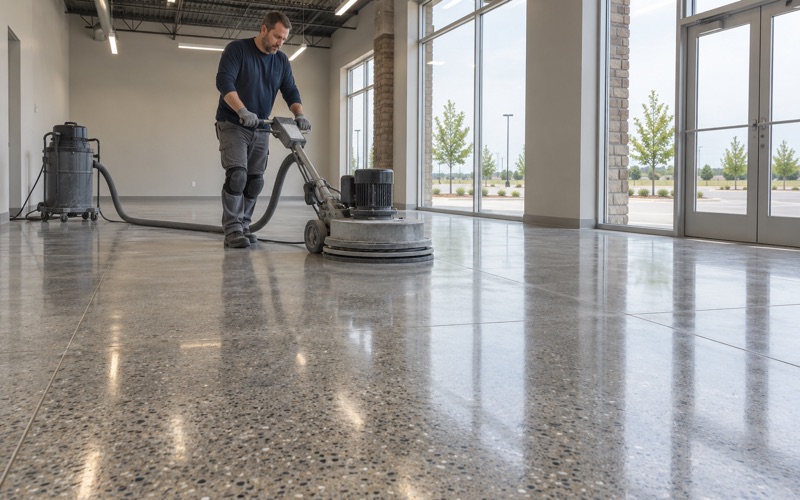
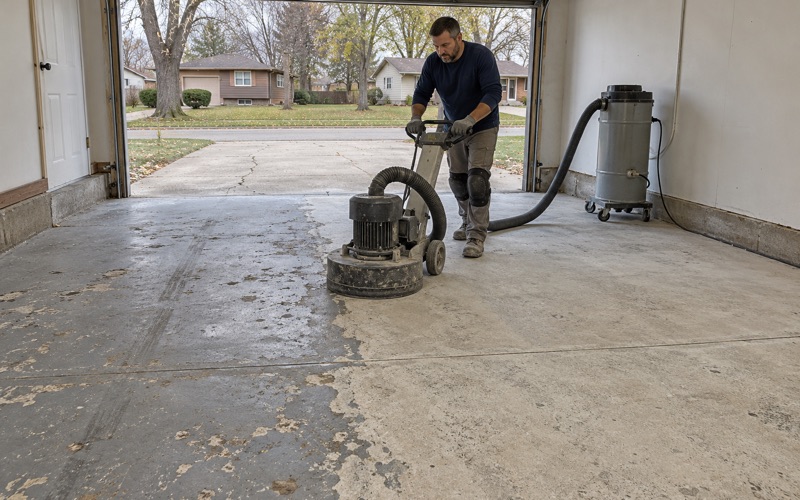
Once the slab is mapped and tested, we grind or shot blast it to an ICRI concrete surface profile the chosen system calls for. Dust is captured at the machine with a vacuum, never rinsed toward a floor drain or out the overhead door. That matters in a shop where the floor drain may lead somewhere nobody has traced.
Cure timing follows slab temperature and the dew point spread at the surface, not the calendar. An unheated machine shed in a central Iowa winter is usually told to wait for warmer weather, because a coating laid on a cold, damp slab can suffer amine blush and poor adhesion.
Timing a farm floor also means working around the farm. A shop that cannot sit empty during planting or harvest can be phased, with one bay coated while equipment moves to another, and overnight or weekend windows when a building cannot stop.
Oil, Hydraulic Fluid and Fertilizer in a Working Shop Floor
What Years of Use Leave Behind
A working ag shop collects residue that a garage rarely sees. Engine oil, hydraulic fluid from leaking lines and fertilizer tracked or spilled during the season can all work their way into the concrete. Residue is one item on our inspection list, and on some floors it is the item that sets the prep plan.
Cleaning comes before grinding, not after. Degreasing pulls up what sits near the surface, and the grinder then shows us whether clean concrete lies beneath or whether the stain keeps going.
Ground-in contamination can keep a coating from bonding even after grinding opens the surface. We look for dark staining that comes back after cleaning, and we grind test patches where the floor tells us to. If the residue runs deep, we say so in writing rather than coat over it and hope.
Choosing a System for Equipment and Winter
For a shop floor that sees heavy equipment, we usually look at a 100% solids epoxy base with a quartz aggregate broadcast for texture. Slip resistance comes from the broadcast and topcoat we specify, not from a slogan. Where chemical exposure or thermal shock is a concern, urethane cement can be the better fit.
Trucks and pickups that come in from the road bring brine and rock salt from November through March. We choose systems that hold up to those deicers, often finishing with a polyaspartic topcoat that resists hot tire pickup. Each layer is listed in writing before work begins.
Homes in Town
Not every floor we coat in Nevada, Iowa sits in a shed. Housing here is old and mixed, with 25.1 percent of units built before 1940, and a basement in one of those homes gets the same reading for past water as any shop floor gets for oil.
A newer house is not treated as a safer garage, either. We test every slab whatever year it was poured, and for attached garages and basements we offer low-odor products as a comfort choice, never as something Iowa law requires.
One more line we hold firmly: a floor coating is not radon work. In Iowa, radon testing and mitigation take a state credential under Iowa Code chapter 136B, so we keep that work out of our scope and say so when a basement owner asks.
- 20+ Years on Concrete
- Moisture Tested Before Pricing
- Ground, Never Acid Etched