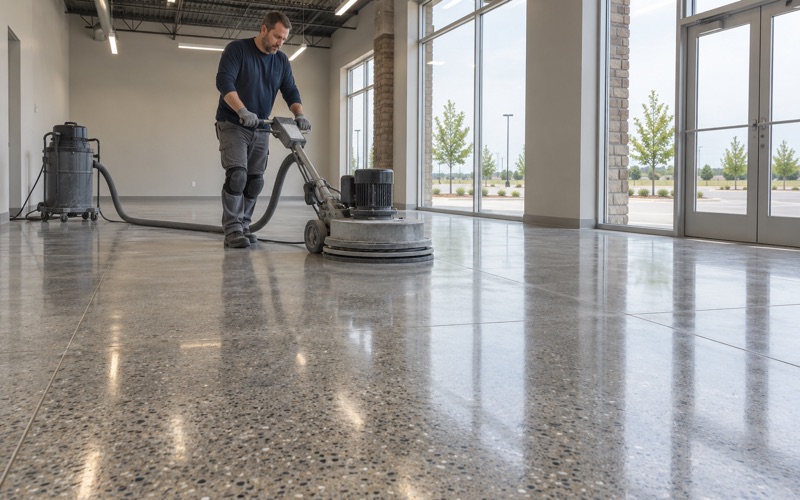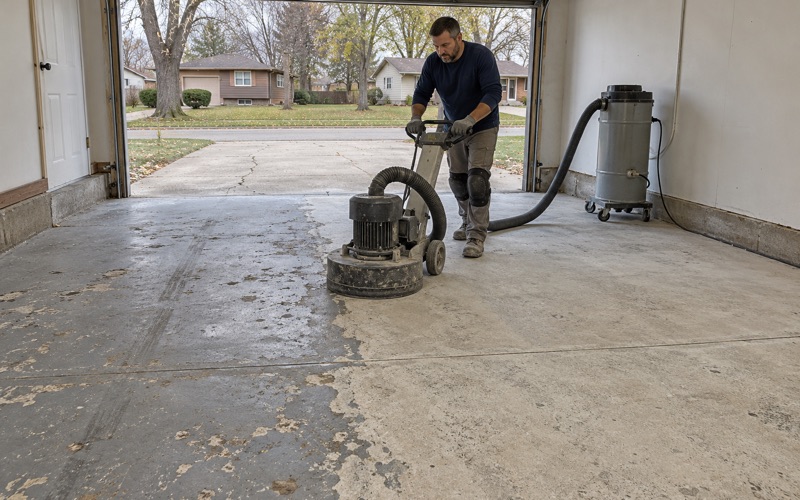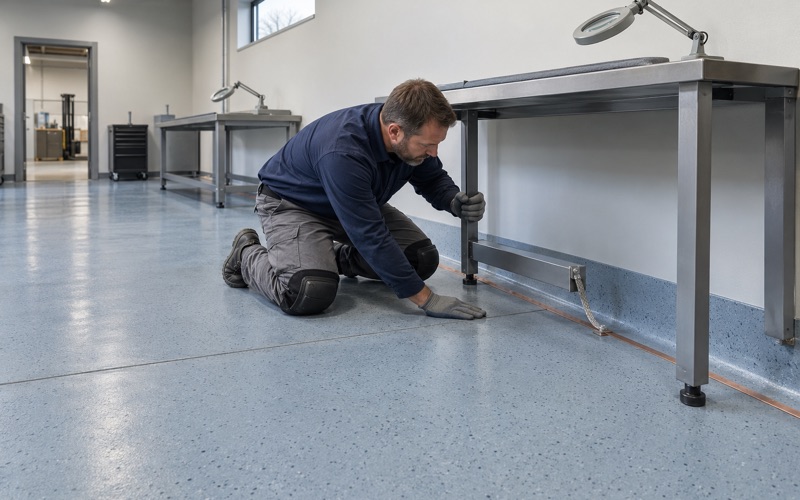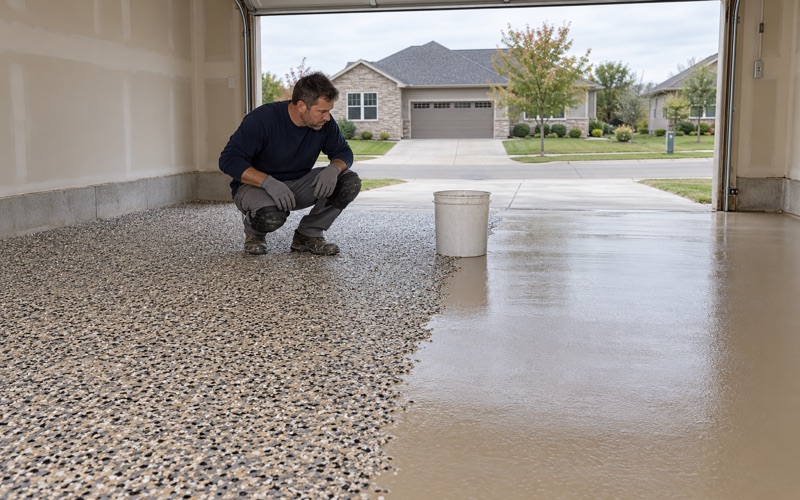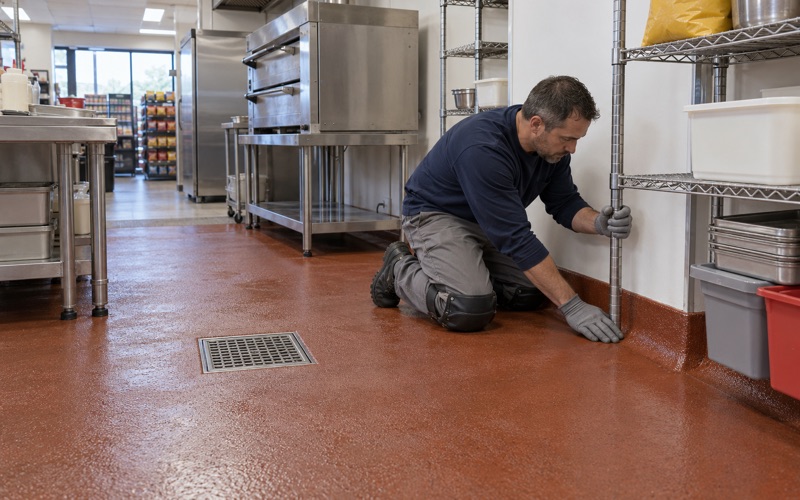
Ankeny Epoxy Flooring brings more than 20 years of epoxy flooring work to Pleasant Hill garages, basements and shop floors, and every job starts with the same question: what has this slab already been through? We open each floor with a diamond grinder or a shot blaster, never an acid etch, because a coating only holds as well as the profile it grips.
In this city, that question has a specific answer for a lot of floors. A slab that sat under creek water needs cleaning, drying and a moisture test before anything is applied, and we put that test in the written scope before the price is final. If the numbers say wait, we tell you to wait.
Our proposals name the product line, the number of coats and the finished thickness, so you can hold the installed floor against the quote. We also explain what a coating warranty excludes before you sign, and moisture is the first exclusion on that list. Nothing on this page should be read as a promise that a coated floor will hold back water, because it will not.
Fourmile Creek’s Two Biggest Floods: 2018 and 2026
The Record Crest of June 30, 2018
Fourmile Creek floods differently from a big river. It rises quickly after heavy rain, which is why the floods that matter on Pleasant Hill floors are flash floods. The record at the Easton Boulevard gauge was set in the June 30, 2018 flash flood, and that storm forced the evacuation of the Pleasant Valley Mobile Home Park.
The same flood closed Vandalia Road, Pleasant Hill Boulevard and Parkridge Avenue for days. Afterward the USGS surveyed high-water marks at 11 locations along Fourmile Creek, starting at State Highway 163 in Pleasant Hill and running north from there, and published them in a report on the June 30 to July 1 flood in the basin.
The Fourth of July Storm in 2026
Over the Fourth of July weekend in 2026, more than a foot of rain fell in two days, and the National Weather Service reported totals of 5 to 10 inches as common across the area. Fourmile Creek reached its second-highest crest at the Easton Boulevard gauge, behind only the 2018 record.
This time the outcome was different. Roads reopened quickly and widespread evacuations were not needed, and the drainage work behind that change is covered further down. For anyone with a floor near the creek, though, both storms teach the same lesson: a flash flood leaves very little warning.
Why a Creek Flood Changes Floor Work
A creek flood does not hand a slab back the way it found it. Floodwater carries silt, oils and whatever it picked up on the way, and concrete is porous enough to take some of that into its surface and hold moisture well after the water is gone.
That is why we treat a flood history as part of the slab’s condition, the same way we treat cracks, spalls and old coatings. We ask whether the floor has ever taken water, and we plan the job around the answer rather than around the calendar.
It also means the date of the last flood matters. A floor that took water in July and is being coated in the fall is a different job from one that has been dry for years, and we want to know which one we are standing on.
Looking for epoxy-flooring closer to Windsor Heights? See Epoxy-Flooring in Windsor Heights.
After a Flash Flood: Clean, Dry, Then Test the Slab
Cleaning Comes Before Anything Else
A floor that has taken floodwater gets cleaned first, and properly. Silt and residue left in the pores sit between the concrete and any primer, and grinding is not a substitute for washing out what the water left behind.
We are a coating contractor, not a cleanup crew, so if a floor still needs flood cleanup we say so and wait until that work is done. Once it is, we look at the surface for staining, efflorescence and soft spots that tell us the water reached deeper than it looks.
Cleaning also shows us what the water did to the old surface. A sealer or earlier coating that sat under water often loosens or turns cloudy, and that helps decide whether diamond grinding will reach sound concrete or whether a shot blast, which cuts a deeper ICRI concrete surface profile, is the better tool.
Drying Takes Longer Than the Surface Suggests
A slab can look dry on top within days while the concrete underneath is still giving off moisture. Coat it then and the vapor pushing up from below has nowhere to go, which is how coatings blister, lift and peel in patches that follow the wettest part of the floor.
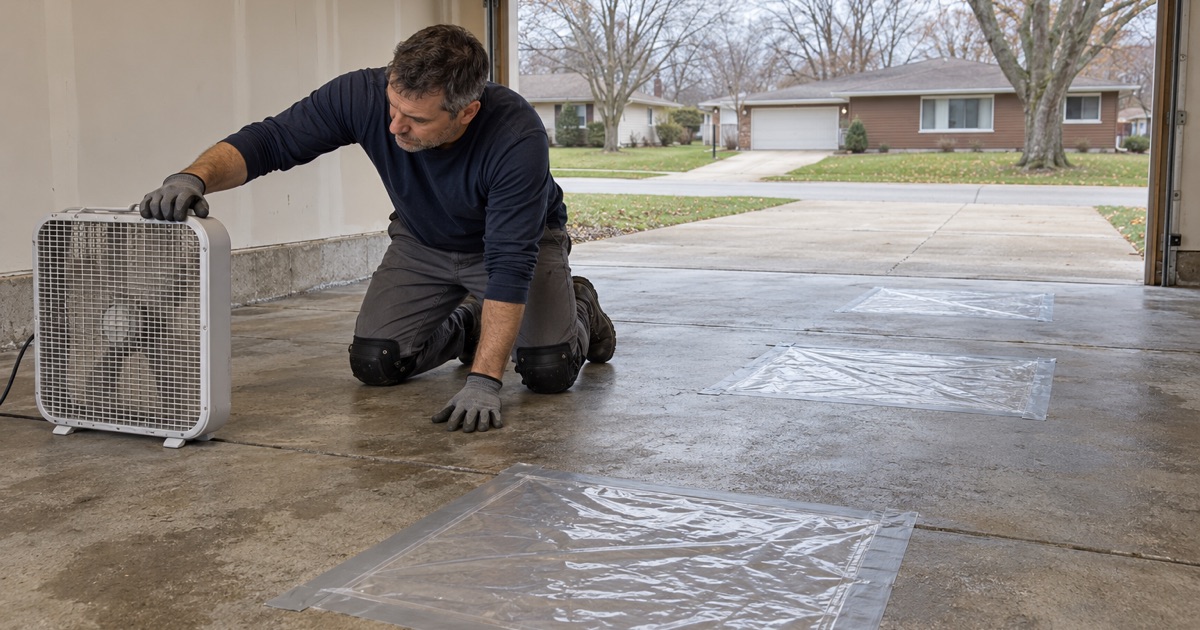
We do not put a fixed number of days on drying, because the slab sets the pace, not the schedule. A garage with the door open and air moving dries differently from a basement slab sitting on wet soil, and the only honest way to know where either one stands is to measure it.
The Moisture Test We Write Into the Scope
Every scope we write includes a moisture test, whether the floor has flooded or not. Depending on the slab, that can be an ASTM D4263 plastic sheet test as a first read, an ASTM F1869 calcium chloride test for moisture vapor emission rate, or ASTM F2170 in-situ relative humidity probes set into the concrete.
On a floor with a flood history, we lean on the probe readings, because they show what is happening inside the slab rather than at its surface. If the results come back high, the options are more drying time or a moisture-mitigation primer rated for the reading, and we tell you which one the numbers support.
Testing protects you as much as it protects the floor. A reading taken and written down before the job means the warranty conversation starts from a known number, and it means a later problem can be traced to a cause instead of argued about.
Drains, Sump Pits and the Edges a Coating Leaves Alone
Floor Drains Stay Open
In a flood-prone town, a floor drain earns its place. We coat up to and around the drain body, never over the grate or into the throat, so the drain keeps doing its job the next time water gets onto the floor.
Grinding near a drain also needs care. We capture dust at the machine with a vacuum rather than rinsing it toward a floor drain or a storm inlet, which matters in a city where so much depends on the storm system staying clear.
Thickness matters at a drain, too. A self-leveling or broadcast system adds build to the floor, so we check that the finished surface still pitches toward the drain and that the edge of the coating meets the drain body cleanly rather than forming a lip that holds water.
Sump Pits and the Basement Perimeter
In a basement, the sump pit and the drain tile that feeds it are part of how the house handles groundwater. We check the pit before we quote, leave the lid and the pit opening uncoated and accessible, and keep the coating from sealing over any perimeter channel that carries water to it.
We also read a basement floor for past water before we recommend anything. Tide lines, efflorescence along the walls and rust at the base of posts all tell a story, and a coating does not stop seepage or hydrostatic pressure pushing up from under the slab.
When a Slab Should Not Be Coated Yet
Some floors are not ready, and we would rather say so than sell a coating that fails. Before any quote, we map cracks, spalls and old coatings, and we tell you plainly when a slab needs repair or replacement first.
A floor that keeps taking water from below, or one where the readings will not come down, is a case for fixing the water problem before coating. Our warranty explanation spells out that moisture vapor transmission and hydrostatic pressure are excluded, so nobody learns that after the floor is down.
City Drainage Work, Townhouse Garages and Manufactured Homes
The Southeast Connector and the Parkridge Avenue Culvert
Since 2018, Pleasant Hill has put real work into how water moves through town. The Southeast Connector raised the South Pleasant Hill Boulevard and Vandalia Road intersection out of the floodplain, consolidated railroad crossings and connected stormwater detention.
In 2025 the Parkridge Avenue culvert was replaced with a 14-by-6-foot box culvert and new storm sewer, and tributary banks near the city cemetery were stabilized after a 2024 tornado. The city is also a member of the county-led Fourmile Creek Watershed Management Authority and plans restoration along Fourmile and Little Fourmile creeks with Polk County.
What a Coating Cannot Do
Culverts, raised roads and stormwater detention are what change how a flash flood behaves. A floor coating does none of that and will not stop water from entering a garage or a basement, so we never sell one as if it could.
What a well-built system does offer is a surface that is easier to clean after water and debris have been across it. A 100% solids epoxy base with a polyaspartic topcoat sheds silt better than bare concrete, and a dense, sealed floor gives a cleanup crew less to scrub out of the pores.
For a garage that has flooded before, we usually recommend a broadcast that gives a little texture underfoot when the floor is wet. That texture comes from the vinyl flake or quartz aggregate we specify and the topcoat over it, and the proposal names both, so slip resistance is something you can check rather than a slogan.
Townhouse Garages and Manufactured Homes
Pleasant Hill has a large share of townhouses: 16.2 percent of housing units are single-family attached, and 14.0 percent of owners live in one. Most of the housing went up between 1990 and 2019, which accounts for 64.9 percent of units, but we test every slab whatever year the house was built.
A townhouse garage sits close to living space, and often close to a neighbor’s, so we offer low-odor products as a comfort and re-entry choice, not as anything Iowa requires. Owners should also check with their association before scheduling, since shared driveways and access rules can shape the job.
The city also has 129 mobile homes, all owner-occupied in the Census estimate, and the 2018 evacuation described above is part of why flood history is the first thing we ask about here. Where a manufactured home comes with a detached concrete garage or shop slab, we approach it the same way: clean, dry, test, then coat.
- 20+ Years on Concrete
- Moisture Tested Before Pricing
- Ground, Never Acid Etched