
Ankeny Epoxy Flooring grinds and finishes polished concrete floors in Ankeny, IA, serving surrounding cities including Saylorville, Johnston, Polk City, Bondurant and Altoona. Polishing turns the slab itself into the finished floor, with no coating on top to peel, and our 20+ years of grinding concrete in central Iowa is what makes the difference between an even polish and a blotchy one.
A polished floor is made by grinding away the top of the slab with diamond tooling, hardening the concrete with a densifier, then working through finer and finer diamonds until the surface reflects light. Every slab polishes a little differently, because the stone, sand and paste were mixed and finished differently when it was poured.
That is why every polished concrete job we take starts with a test area on your own floor. You see the aggregate, the color and the sheen before the full grind, and the proposal states how deep we will go, which densifier and guard we will use, and the final polish level.
How a Concrete Floor Gets Polished
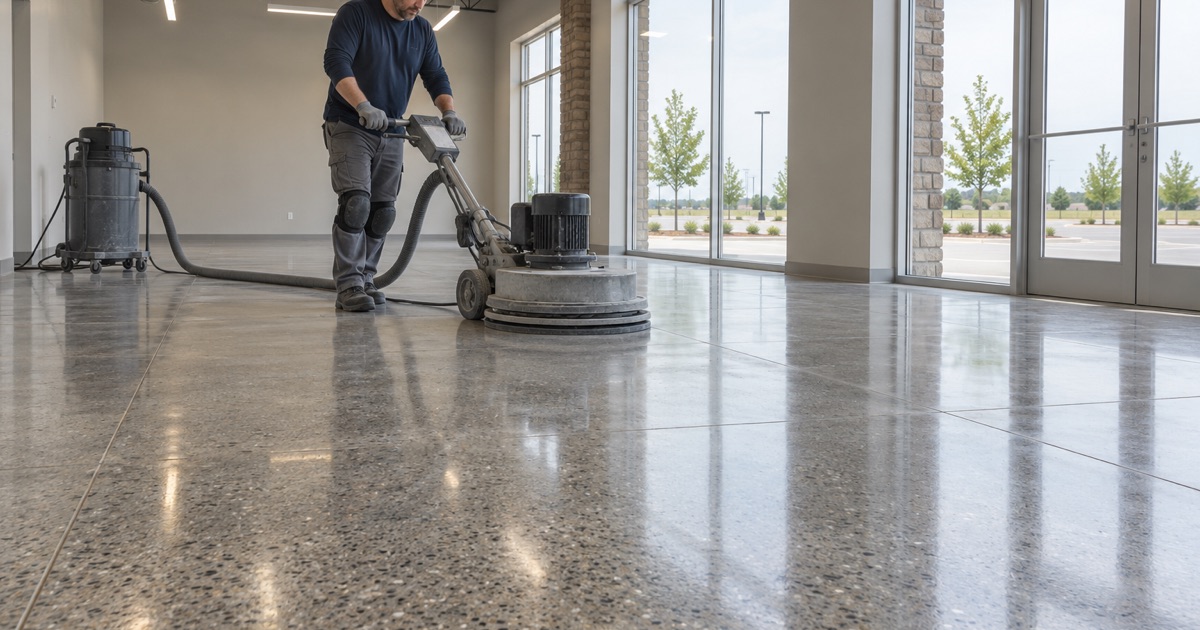
The Diamond Grinding Sequence
The first pass uses coarse metal-bond diamonds to cut through the surface, take off sealers and old coatings, and flatten the slab. Each pass after that uses a finer grit to remove the scratches left by the one before it, until the surface is smooth enough to start polishing with resin-bond diamonds.
Skipping a grit is the most common shortcut, and it leaves swirl marks that show up as soon as light hits the floor at an angle. We run every step in sequence and check the scratch pattern before moving on, and dust is captured at each machine by a vacuum rather than swept or rinsed away.
Lithium Silicate Densifier
Partway through the sequence, the floor is soaked with a lithium silicate densifier. It reacts with the free lime in the concrete to fill the pores, which hardens the surface so it takes a sharper polish and resists abrasion and dusting.
Lithium densifiers are applied in a controlled amount and leave little residue, so the floor is ready for the next grit without a long wait. On softer slabs we may apply a second treatment, because a well-densified floor holds its shine through years of foot and wheel traffic.
Polish Level and the Final Guard
The last resin grit sets the sheen, from a low satin to a high, mirror-like reflection. Higher is not automatically better: a high polish shows every scuff in a busy area, while a satin finish hides wear and suits most shops and basements.
A penetrating guard goes on after the final polish to add stain resistance without building a film on the surface. It is the layer that keeps a coffee spill or a drip of oil from soaking in, and it is renewed during routine maintenance rather than stripped and recoated.
Choosing the Look
Cream, Salt and Pepper or Full Aggregate Exposure
How deep the first grind goes decides what the floor looks like. A cream finish stays in the top paste and shows little stone, salt and pepper exposes the fine sand and small aggregate, and full exposure grinds deeper to reveal the larger stone throughout the slab.
Deeper exposure takes more grinding and reveals more of what is in the concrete, including any variation in how the stone settled when it was poured. The test area is how you decide, because the same exposure level looks different on every slab.
Dyes and Color
Polished concrete can stay its natural gray or take a color. Penetrating dyes go into the concrete during the grind, so the color becomes part of the floor rather than a layer on top. Dyes can also separate zones, such as a customer area and a work area in the same building.
Dyes take differently on denser and softer areas of a slab, so the color has some natural variation. We show a dyed sample on your floor before the full job so the color you approve is the color you get.
What the Slab Itself Decides
Polishing reveals the slab rather than covering it. Old patches, saw cuts, tile adhesive outlines and repaired cracks will show in the finish, sometimes more clearly than before. Many owners like that character, and others prefer a coating that hides it.
We map those features before we quote and tell you honestly how they will read in the finished floor. When a slab has too much damage or patchwork for the look you want, we say so and talk through a coated alternative instead.
Commercial Polished Concrete Floors
Warehouses, Retail and Showrooms
Polished concrete is a common choice for warehouses, retail floors and showrooms because it has no coating to wear through under forklift and cart traffic. It brightens a space by reflecting light, and on a large, sound slab it is one of the lowest-maintenance hard floors available.
In a working warehouse we plan joint fills and line striping with the polish, and we keep the sheen at a level that stays even under constant traffic. Showrooms often go for a higher polish and deeper aggregate exposure, where the floor is part of the display.
Maintaining a Commercial Polish
A polished floor is maintained by cleaning, not by stripping and recoating. An auto-scrubber with a neutral cleaner and a fine diamond-impregnated pad keeps the shine up as part of the normal cleaning routine.
Over years of heavy traffic, the main aisles may lose some gloss. A light burnish or a quick repolish with the finest grits brings them back without starting over, which keeps the long-term cost of the floor low.
Working Around a Business
Polishing produces no curing coating and no strong odor, which makes it easier to schedule in an occupied building than many resin systems. We still phase the work around shifts, with overnight and weekend windows when an area cannot close during the day.
The floor can take traffic as soon as each section is finished. We section the job so aisles, entrances and work areas reopen in an order that keeps the business running while the grinding moves through the building.
Residential Polished Concrete Floors
Basements and Lower Levels
A polished basement floor gives a finished lower level a modern, durable surface that does not trap moisture under a film. That makes it a good fit for basements, though it does not solve water problems. We still look at the sump pit, the drain tile and any signs of past water before we grind, because polishing does not stop seepage.
Polished concrete can be cool underfoot, so many owners pair it with area rugs. Where the floor will sit under furniture and rugs most of the time, a satin sheen and a cream or salt and pepper finish usually look best.
Why We Usually Coat Garages Instead
Polished concrete is still bare concrete, and a garage in central Iowa takes in brine and rock salt from November through March. Salt and freeze-thaw cycles can etch and scale a polished surface near the door faster than they wear a sealed coating.
For most garages here we recommend a coating system instead, and we say so when you ask about polishing one. A heated garage used more like a shop or showroom can be an exception, and we talk through that case on its own terms.
Planning Polish on a New Slab
The best polished floors start before the concrete is poured. A slab placed with polishing in mind, with a consistent finish and protected from damage during construction, needs less grinding and polishes more evenly.
If you are building or finishing a basement, we can talk through the finish, joint layout and protection with your builder ahead of time. A new slab still needs time to cure before it is polished, and we schedule the work around that timeline.
- 20+ Years on Concrete
- Moisture Tested Before Pricing
- Ground, Never Acid Etched