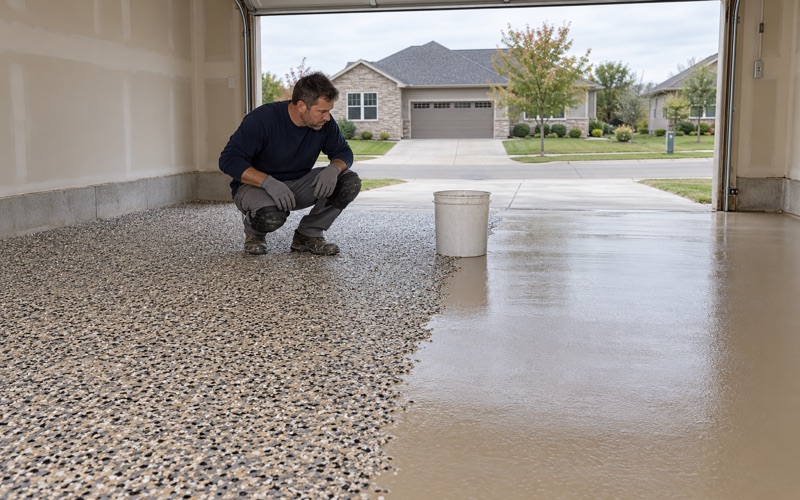
Ankeny Epoxy Flooring brings more than 20 years of slab work to epoxy flooring in Saylorville, and the first thing we do on any floor here is look at its cracks before we talk about color or flake. A coating is only as steady as the concrete under it, so the cracks tell us what kind of floor the slab can actually carry.
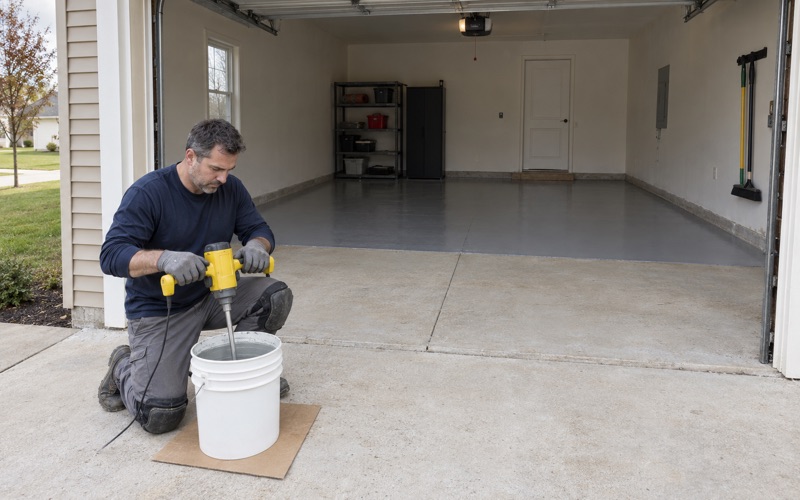
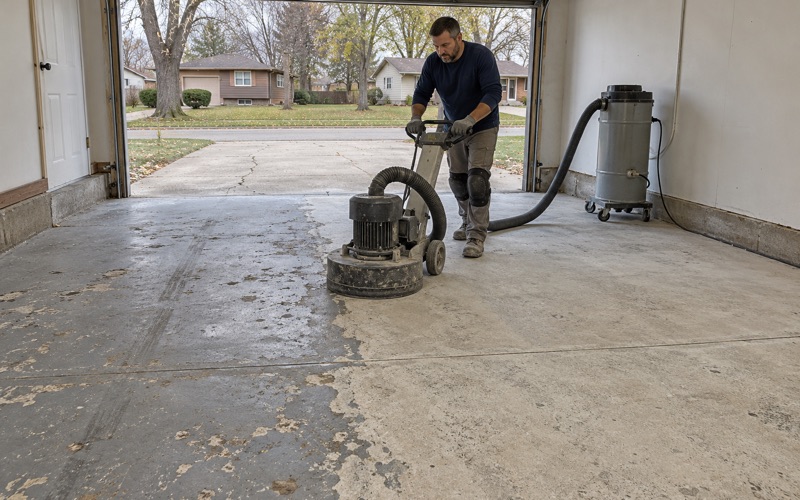
Every garage, basement and shop floor we take on is opened mechanically, by diamond grinding or shot blasting, so the 100% solids epoxy or polyaspartic topcoat has a real profile to bond to. Acid etching is not part of how we work. The written proposal lists the product line, the coat count and the finished thickness, which gives you a way to check the finished floor against the quote.
This page explains why cracks get so much of our attention in this particular community, what we look for when we read one, and how a crack that is still moving changes the plan. It also shows how to look up the state’s mine record for your own address before we arrive.
Coal Under Saylor and Crocker Townships
Room-and-Pillar Mines Worked From 1894 to 1928
Saylorville is a census-designated place in Saylor and Crocker townships of Polk County, and coal mining played an important part in its early development. The Iowa Department of Natural Resources keeps a coal-mine map built by the Iowa Geological Survey from old mine maps and State Mine Inspector records, and a box drawn around the community on that map returns nine abandoned underground mines.
Most of them were worked by the room-and-pillar method between 1894 and 1928, with shafts recorded at roughly 180 to 285 feet deep. Miners cut rooms out of the coal and left pillars standing to hold up the rock above. The Bloomfield Coal Co. Marquisville Mine combined that method with longwall work and was mined on two levels.
Pillars, Gaps and Missing Maps
The record is not uniform. At the Western Coal Co. Saylor Mine, the map notes that part of the pillars were removed in 1908, and pillars are what the method relied on for support.
The Anderson Coal Co. mine has no surviving map at all, so its exact extent is unknown, and the Swanwood Coal Co. workings are mapped only in part.
None of this means a particular house or shop in Saylorville is sitting over a void, and we did not find any record of ground movement here. The map is a historical record, not a damage report. What it does do is give us a reason to read every crack carefully instead of filling it and moving on.
The Marquisville Mine Beneath NE 14th Street
The most specific entry sits under a county address. Polk County Public Works has its headquarters at 5885 NE 14th Street, and although the mailing address reads Des Moines, the Census geocoder places that address inside the Saylorville CDP, in Saylor township.
Query the DNR map at that point and it returns one feature: the Des Moines Coal Co. Marquisville Mine, a room-and-pillar mine worked from 1894 to 1907 through a 180-foot shaft in the Blackoak coal of the third vein. The mine’s record includes the note that it underlies the county home. Whether today’s Public Works campus is the same ground as that old county home is something the record does not settle, and we do not claim it.
Industrial listings on the same street, at 6950 and 6990 NE 14th Street, carry a Saylorville locality, and we make no claim about what lies beneath any given lot. The point is simpler: mapped workings are part of the local ground record, and a floor plan here should start from that.
Looking for epoxy-flooring closer to Johnston? See Epoxy-Flooring Services in Johnston.
Reading a Crack Before Anything Is Coated
New, Growing or Offset
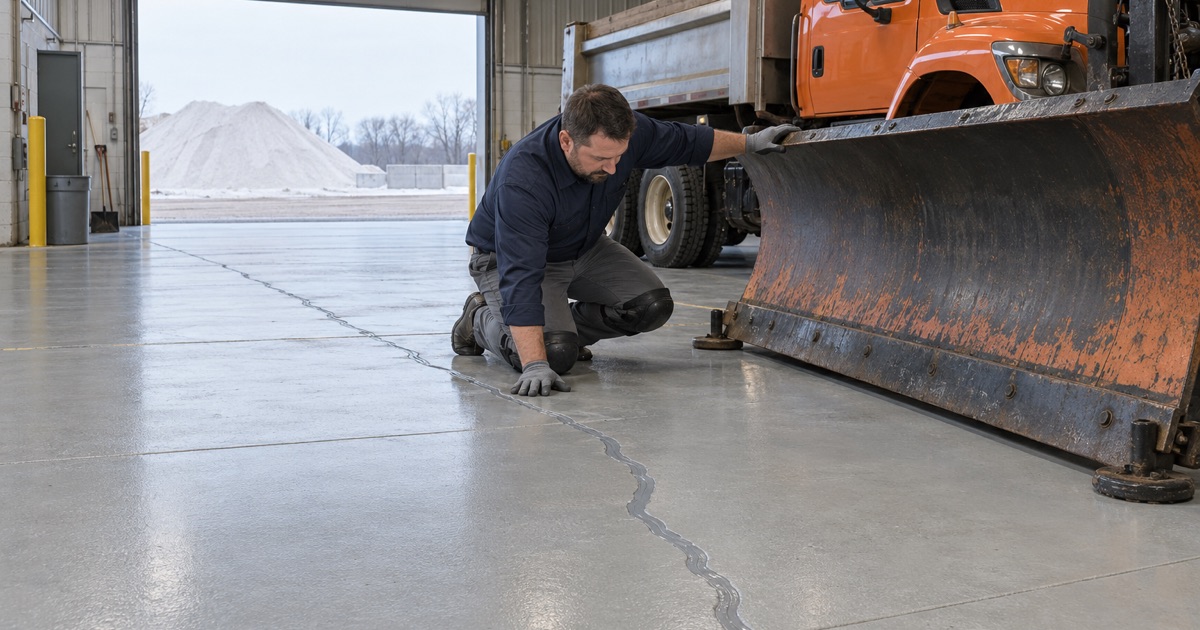
When we walk a slab, every crack, spall and patch of old coating goes onto a sketch before the price is final. For each crack we want to know three things: whether it is new, whether it has grown, and whether one side now sits higher than the other. A hairline shrinkage crack that has looked the same for years tells a very different story from one that has widened since last winter.
Owners usually know more than they think. Old photos, a crack that came back through a previous paint job, or a line that has crept past a mark someone made years ago all help us date the movement. Where the history is unclear, we would rather mark the crack and check it again than guess.
Telling You When a Slab Is Not Ready
Some slabs should not be coated yet, and some should not be coated at all until the concrete is repaired or replaced. If a crack is still opening, or a section has dropped, we say so in writing instead of selling a finish that is likely to split along the same line.
That conversation also covers the warranty. We explain what a coating warranty leaves out before the job is sold, and moisture is the first exclusion we name, with moisture vapor transmission and hydrostatic pressure spelled out. A moisture test sits in the written scope on garage and basement slabs alike, so that exclusion is discussed with a reading in hand rather than as fine print.
The Same Test on Every House
Saylorville’s housing is almost entirely owner-occupied detached homes, with Census figures showing 93.7 percent of occupied units owned and 96.1 percent of units detached, and the largest share built in the 1960s. Those numbers suggest that most floors here sit in home garages and basements, but they do not change the inspection. A newer house gets the same crack map and the same slab test as an older one.
Why a Moving Crack Becomes a Joint, Not a Patch
A Coating Follows the Slab
A floor coating is a thin film bonded to the concrete. It follows the slab wherever the slab goes, which is exactly what makes it durable on sound concrete and exactly why it cannot hold a crack closed. No epoxy, polyaspartic or polyurea topcoat bridges or stops a crack that is still moving, whatever is causing the movement.
Filling a live crack with rigid epoxy paste and coating over it looks tidy on the day we leave. Then the slab moves, the filler and the film above it split along the old line, and the repair turns into a visible scar running through an otherwise good floor. Over mapped workings, we would rather plan for that line than pretend it will stay put.
Detailing the Crack as a Joint
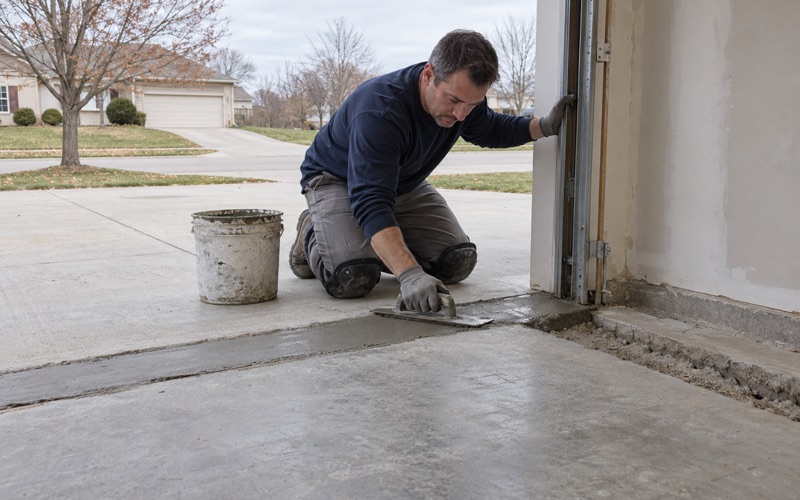
When a crack shows signs of movement, we treat it the way we treat a control joint. The coating system is stopped and terminated cleanly at each side, and the gap is filled with a flexible joint material instead of a rigid filler, so the floor can open and close along that line without tearing the surface around it.
A joint does not fix whatever is moving the slab, and we never describe it that way. It is a detail that keeps a coating looking intentional when the concrete under it is not perfectly still. If the movement looks larger than a joint can absorb, the right next call is a concrete or structural professional, not a thicker coat.
Choosing the System Around the Joints
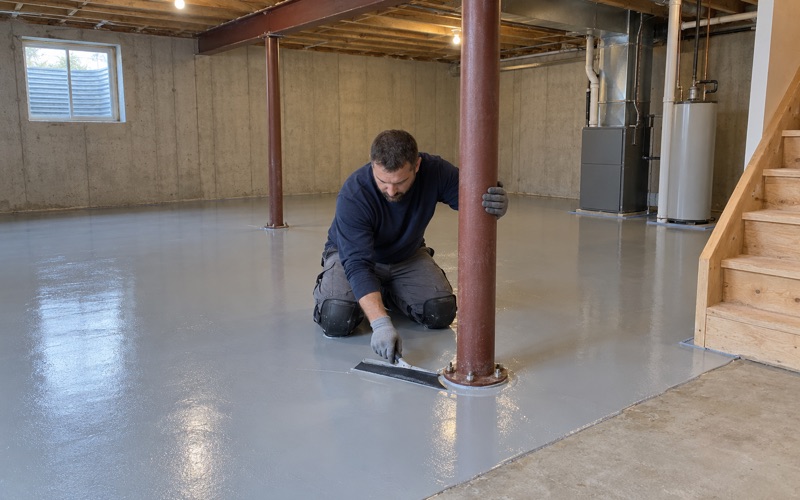
Once the joints are laid out, the rest of the floor is specified like any garage we coat in central Iowa. The slab is ground to the ICRI concrete surface profile the product calls for, then built up with a 100% solids epoxy base, a vinyl flake or quartz aggregate broadcast, and a polyaspartic or polyurea topcoat chosen to stand up to the brine and rock salt that ride in on tires from November through March.
Cure timing follows slab temperature and the dew point spread at the surface, not the calendar. An unheated Saylorville garage in the middle of winter is usually told to wait, because a coating that cures cold can blush or soften, and the joints we just detailed deserve a floor that cured properly around them.
Checking the DNR Mine Map and the County Permit
Looking Up Your Own Address
The DNR’s coal-mine map is public, and anyone can look up an address on it before a floor project starts. Its database records more than three thousand mine sites in Iowa, with mined extent known for about 830 underground mines. Zoom to your lot and check whether a mapped mine polygon covers it or sits nearby.
A polygon over a property is not a verdict on that property. It tells you old workings were mapped there, and a 1989 report on mines in Des Moines and vicinity mentioned that 62 mines had not been found, so a blank spot is not a guarantee either. Bring what you find to the estimate, and we will factor it into how closely we read the cracks.
Permits From Polk County, Not a City Hall
Because Saylorville is unincorporated, there is no city building department. New construction and additions here are permitted and inspected by Polk County Public Works through its Building Services office under the Polk County Construction Code, and the inspection line is 515-286-3352.
Whether a floor project needs a permit is the county’s call, not ours, and a new garage, an addition or a replaced slab is the kind of work to ask about. County permits lapse if work does not start within 180 days or is not finished and inspected within a year, which matters when a coating has to wait on new concrete. We have no relationship with the county office, so confirm the project with Building Services directly.
Shops, Kitchens and Dust Control
Commercial floors along the NE 14th Street corridor get the same crack reading, with the work phased around shifts and run overnight or on weekends when a line cannot stop. Grinding dust is captured at the machine by vacuum rather than washed toward a floor drain or storm inlet.
Food businesses in Saylorville answer to the Iowa Department of Inspections, Appeals and Licensing rather than a city or county health department. For those kitchens we plan around the 2017 FDA Food Code Iowa adopts, with coved bases at the wall and a slip-resistant texture set by the broadcast and topcoat we specify.
- 20+ Years on Concrete
- Moisture Tested Before Pricing
- Ground, Never Acid Etched