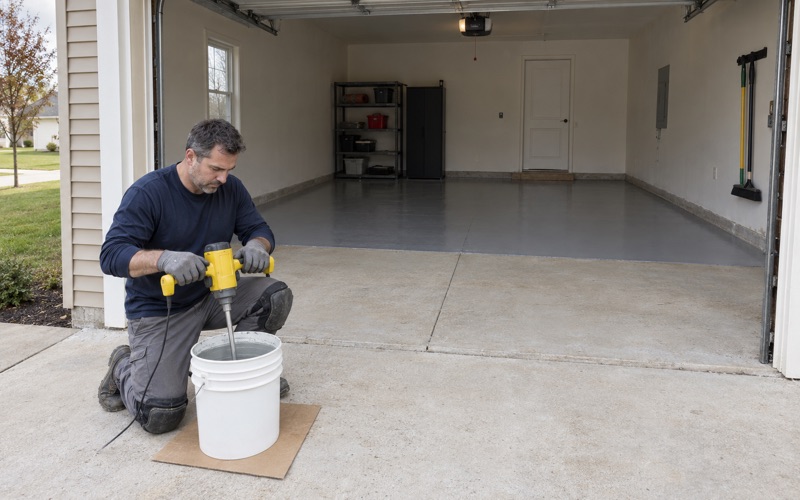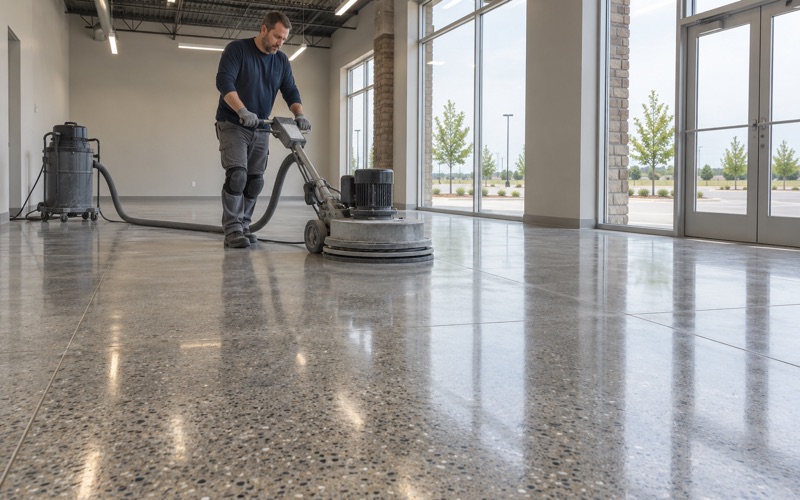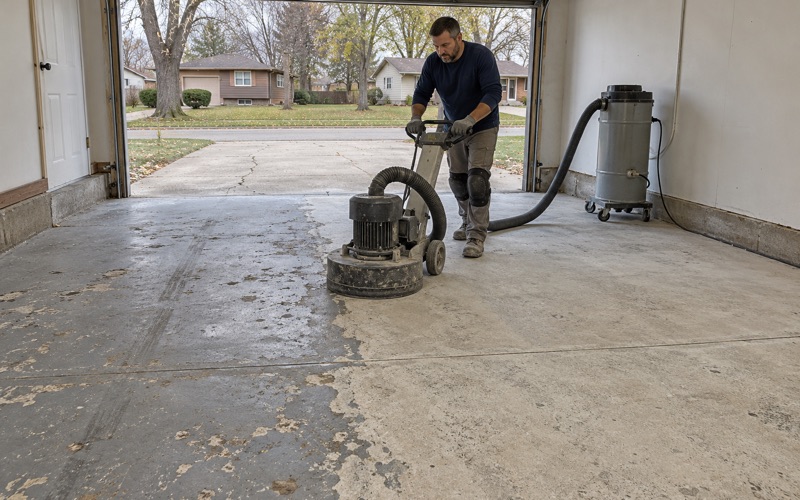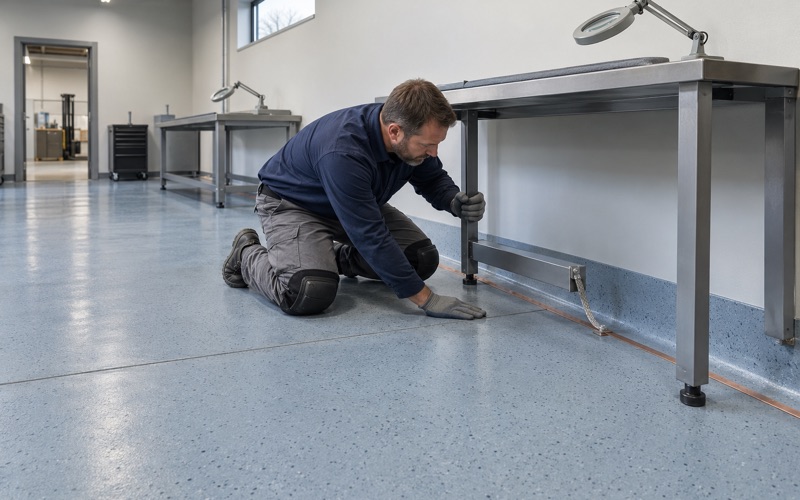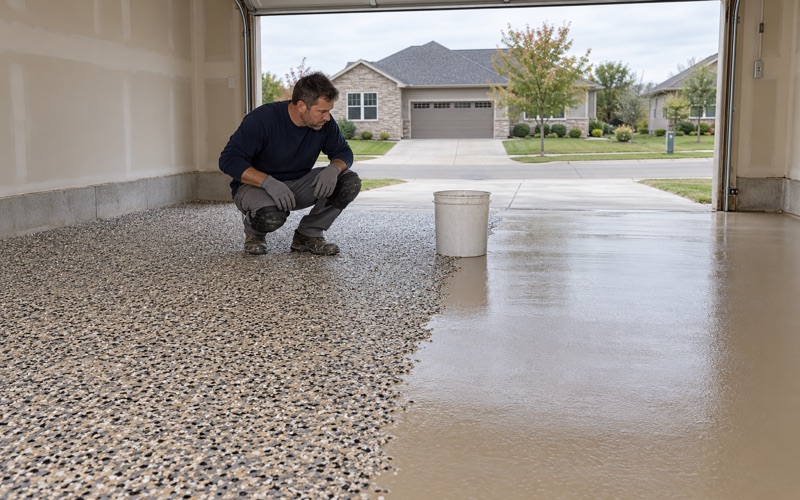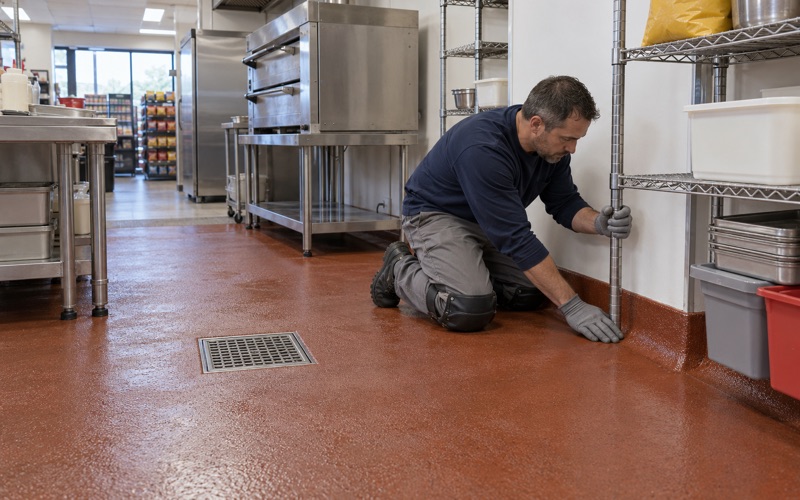
Ankeny Epoxy Flooring has spent more than 20 years on epoxy flooring in West Des Moines and across central Iowa, and the work always starts at the slab rather than the color chart. Every floor we coat is opened with a diamond grinder or a shot blaster, never an acid etch, so the resin has a measured profile to bite into. That single step decides more about how long a coating lasts than the brand on the pail.
Before a price is final, a moisture test goes into the written scope, and the proposal names the product line, the number of coats and the finished thickness. You can hold the finished floor up against the quote and check it. We also map cracks, spalls and old coatings first, and when a slab needs repair or replacement before it should be coated, we tell you that instead of selling a system over it.
Some floors in this city come with an extra party at the table. A building in a historic district that is being rehabilitated under a tax credit has its finishes reviewed against federal standards, and the floor is one of them. This page explains how that review works, where a coating can fit, and where the decision belongs to someone other than us.
Valley Junction and the 53 Buildings on Fifth Street
A railroad town with a new name
Valley Junction grew up around the Chicago, Rock Island and Pacific Railroad depot, and its crossing rail lines gave the village its name. It was officially founded in 1893 and became home to car shops and roundhouses. After three attempts, citizens voted to rename Valley Junction as West Des Moines at the end of 1937.
The old commercial core still reads as that railroad town. The one- and two-story brick buildings along Fifth Street run from the 1893 to 1901 era on the south side to inter-war Moderne and Art Deco fronts on the north, with post-war concrete block mixed in. The railroad’s shops are gone, but the storefronts they supported still line the street.
What the 2017 listing covers
The Valley Junction Commercial Historic District was added to the National Register of Historic Places on October 11, 2017. It counts 72 resources, including 53 contributing buildings, across most of three blocks of Fifth Street and parts of two cross streets, roughly 100 to 318 Fifth Street. Design guidelines for the district followed in 2022.
A contributing building is one the listing counts toward the district’s historic character, and that status is one of the routes into the state rehabilitation credit. It is also what puts a reviewer between the owner and the floor. For a coating contractor, the practical effect is simple: on these addresses we ask about the credit before we talk about resin.
One city, several counties
Most of West Des Moines is in Polk County, some of it is in Dallas County, and small portions extend into Warren and Madison Counties. Valley Junction itself sits in Polk County. Which county a parcel falls in decides its assessor, and assessed value comes up again in the credit rules below.
The City of West Des Moines building division handles permits inside city limits. We confirm what a given job needs with that office at the start, rather than assuming the rules of a neighboring city carry over. Permits and historic review are separate tracks, and clearing one does not clear the other.
Looking for epoxy-flooring closer to Carlisle? See Epoxy-Flooring Services in Carlisle.
Iowa’s 25 Percent Historic Tax Credit and the Federal Standards
What chapter 404A asks for
Iowa’s historic tax credit under chapter 404A of the Iowa Code equals 25 percent of qualified rehabilitation expenditures. A qualified project includes property listed on the National Register or designated as of historic significance to a National Register district. For commercial property, expenditures have to reach at least 50,000 dollars or 50 percent of assessed value excluding land, whichever is less.
The same law requires the rehabilitation to meet the physical standards set by rule, consistent with the Secretary of the Interior’s standards for rehabilitation. Those standards are written for the whole building, and they reach down to the floor. A finish chosen without them in mind can put a credit at risk, which is why the owner and the reviewer settle it before any contractor does.
Where we stand in a credit project
We do not qualify projects for the credit, prepare applications or speak for the state. We have no relationship with any Valley Junction property, the city or the district’s preservation groups, and we offer no consulting on historic review. What we bring is a slab assessment the owner’s team can use when they make their case.
That assessment covers the same ground it does anywhere: cracks, spalls and old coatings mapped, a moisture reading taken, and a written note on whether the concrete is sound enough to coat at all. If the reviewer wants the existing floor kept, we do not argue for a coating. If a replacement surface is approved, our written scope follows the approval, not the other way around.
Floors outside the district
Most of this city is not a railroad town at all. Of its 34,006 housing units, 57.9 percent were built in 1990 or later, and 42.6 percent of occupied units are rented. Owner-held townhouses, 2,886 of them by census count, are a real share of what owners hold.
A newer house does not get a lighter inspection from us. Whatever year the home was built, the garage slab is tested, and the system is chosen to stand up to the brine and rock salt that ride in on tires from November through March. Cure schedules follow slab temperature and the dew point spread at the surface, so an unheated garage in a central Iowa winter is told to wait.
Repair First: The Park Service’s 2025 Flooring Guidance
What the guidance actually says
The National Park Service published guidance on historic wood flooring and substitute materials, last updated July 30, 2025. Its starting point is that deteriorated historic features and materials should be repaired rather than replaced if they are in repairable condition. Total replacement may be acceptable when the flooring is beyond reasonable repair.
A substitute material can be acceptable for deteriorated or missing flooring when economic or technical factors justify it, such as leveling a floor for accessibility or code. The guidance says its principles can generally be applied to other types of flooring as well. It does not mention coatings at all, and it does not endorse epoxy or any resinous floor.
Primary rooms and back rooms
The guidance asks whether a floor sits in a primary space or a secondary space. The more important and intact the space, the closer a replacement has to match what was there. A storefront sales floor seen from Fifth Street is a different conversation from a stockroom behind it or a utility room in the basement.
Which rooms count as primary is the reviewer’s call, not ours. A back room or a basement utility space is where a coated concrete floor is more likely to be discussed, since the match matters less there by the guidance’s own logic. We can price both kinds of room when asked, and we expect the answers to differ.
Old concrete and a monolithic look
On concrete, the guidance is specific: concrete may be replaced with a resilient flooring or larger format vinyl tile that achieves a similar monolithic appearance. The point is the look of one continuous surface, not a particular product. A seamless resin floor reads as monolithic, but whether it is an acceptable substitute in a given room is still a reviewed decision.
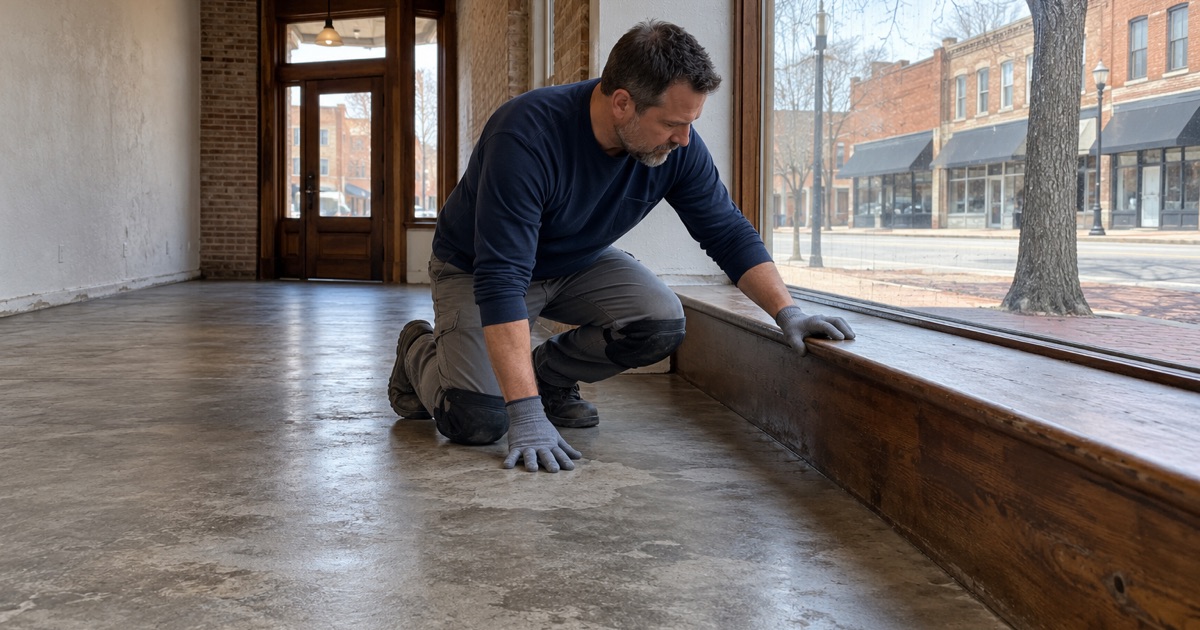
Where a coating is approved over historic concrete, the prep matters more, not less. We profile to the ICRI concrete surface profile the system calls for and capture the dust at the machine with a vacuum instead of rinsing it toward a floor drain. On an old slab, the crack and spall map comes before any sample is laid, and every patch it calls for goes into the written scope.
Storefront Floors With a 1993 Flood History
What the water reached
Unprecedented rains in 1993 brought burst levees and record flooding to Valley Junction. All businesses closed, and buildings took on between 6 inches and 6 feet of water. The city’s offices on Fifth Street were damaged too, and the municipal building moved to Mills Civic Parkway in 2002.
New infrastructure built since then is meant to prevent future flooding. Even so, slabs and basements from that era carry a flood history, including ones that were rebuilt afterward. We have not seen the damage or repair record of any single building, so we treat every slab in the old core as one that may have been wet.
Moisture is tested, never assumed
On these floors we lean on more than one moisture method. An ASTM D4263 plastic sheet test is a quick first read, ASTM F1869 calcium chloride testing gives an emission rate, and ASTM F2170 in-situ relative humidity probes read conditions inside the slab. The results decide whether a moisture-mitigation primer belongs in the system or whether the floor should not be coated yet.
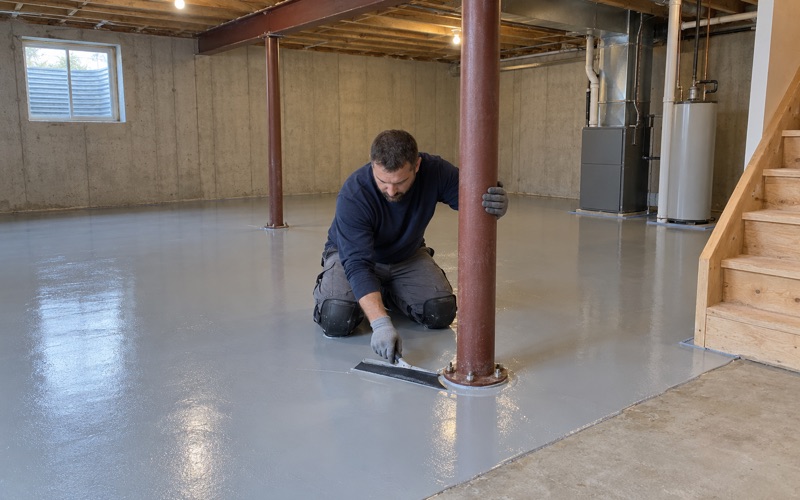
Under the old commercial core, the soil survey maps Nodaway, occasionally flooded, Urban land complex alongside Clarion-Urban land complex and plain urban land. That is not a reason to fear every floor, but it is a reason to test rather than guess. Basements also get a look at the sump pit and drain tile, where they exist, because a coating does not stop seepage.
What a coating will not do
A floor coating is not flood protection and it is not waterproofing. It will not keep water out of a building, and it will not hold back hydrostatic pressure pushing up through a basement slab. Our proposals say that in writing, and moisture vapor transmission and hydrostatic pressure are the first exclusions we explain on any warranty.
It is not radon work either. In Iowa, radon testing and mitigation take a state credential under chapter 136B of the Iowa Code, and a coating is no substitute for that work. If a building owner needs radon addressed, that is a separate credentialed job with its own scope.
None of this makes an old storefront a poor candidate for a coated floor. It means the order of decisions is fixed: the reviewer settles what the room may become, the slab tells us whether it can be coated, and only then do we write a price. Owners who bring us in early get a slab report in time to use it.
- 20+ Years on Concrete
- Moisture Tested Before Pricing
- Ground, Never Acid Etched