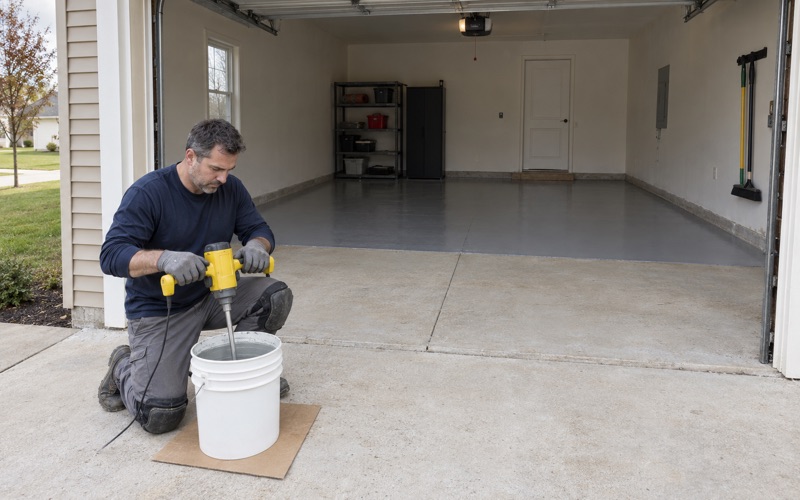
Ankeny Epoxy Flooring brings more than 20 years of epoxy-flooring in Windsor Heights and across central Iowa to every job, and the first thing we look at on an older basement or garage is not the concrete itself. It is whatever was glued to the concrete before us. Resilient tile and the adhesive under it change the order of the job, and sometimes they change who is allowed to do the first step.
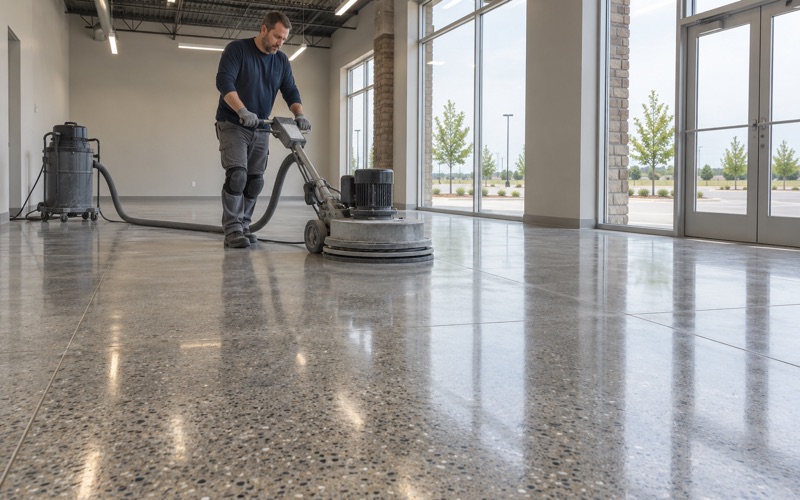
Every coating we put down depends on a clean, profiled slab, and we open that slab with a diamond grinder or a shot blaster rather than an acid wash. Grinding is exactly the step that must not happen over a floor nobody has identified. So on a house of the right age, testing the old tile and mastic comes ahead of the grinder, ahead of the moisture test and ahead of the price.
This page explains why that order matters here in particular, what Iowa law says about old flooring that tests positive, and where a coating fits once the floor underneath is known. We do not hold an Iowa asbestos credential of any kind, and we say so at the first visit, because that limit shapes what we can and cannot quote.
A Town Built Between 1950 and 1969
What the census count shows
Windsor Heights is a small city in Walnut Township, Polk County, part of the Des Moines–West Des Moines metro, and its housing reads like a single building boom. Census estimates count 2,411 housing units, and 774 of them were built in the 1950s and 702 in the 1960s. That is 61.2 percent of the city built between 1950 and 1969.
The rest of the stock does not change the picture much. Another 448 units predate 1950, 269 came in the 1970s, and fewer than 220 have been built since 1980. Of the 1,754 owner-occupied homes, 1,692 are detached houses, which works out to 96.5 percent.
Why the era matters on a floor
A build year does not tell us what is on a floor, and we never treat it as proof of anything. What it does is place a house in the decades when vinyl-asbestos and asphalt tile were common basement finishes, often laid in black mastic straight onto the slab. Many of those floors were later carpeted or covered with a newer layer rather than torn out.
The same thinking runs the other way, too. We test a garage slab for moisture whatever year the house went up, because a newer home is not automatically a safer floor. Age only tells us which questions to ask first, and in this city the first question is usually about the tile.
Moisture depends on where the basement sits
Soil maps around City Hall show two different settings within a short distance. On the Terril and Clarion till slopes the water table sits roughly four feet down, while the low channeled ground of a nearby drainageway holds water much closer to the surface.
That is why a moisture test is written into our scope before a price is final. We use an ASTM F1869 calcium chloride test or ASTM F2170 relative humidity probes, and we read the walls and floor for efflorescence and old water lines. A coating does not stop seepage, so a wet slab gets a moisture-mitigation primer or a frank conversation about waiting.
Looking for garage floor coating closer to Des Moines? See Garage Floor Coating Services in Des Moines.
Old Floor Tile and Black Mastic Under the Carpet
What we usually find
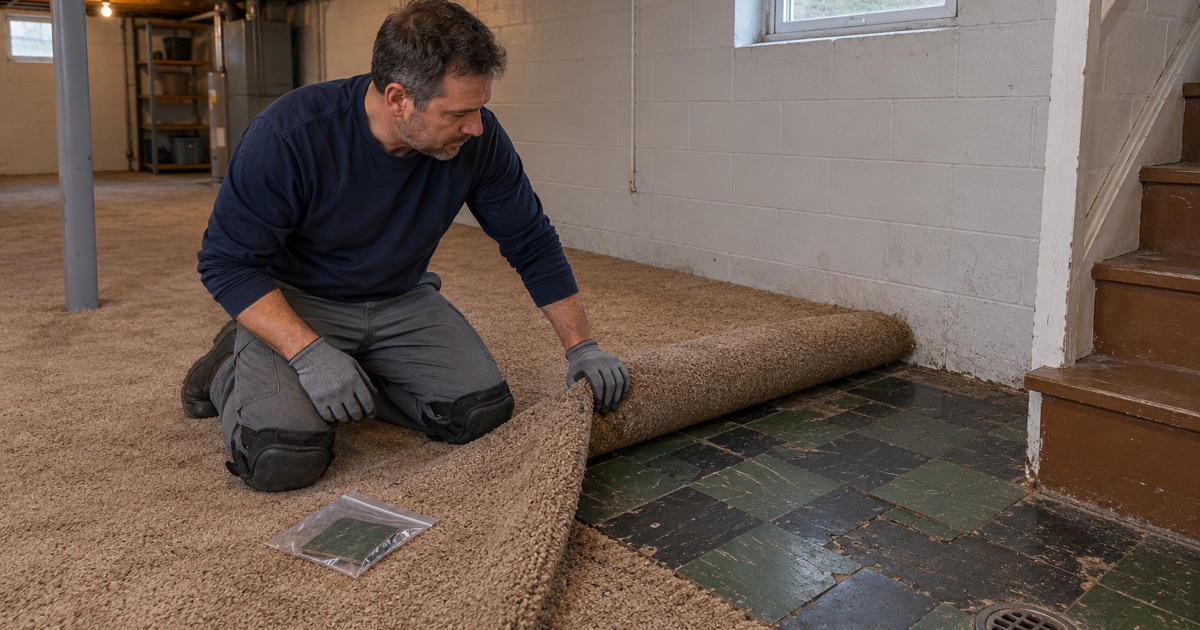
Pull back the carpet in a basement rec room of this age and the layers tell a story. There may be nine-inch or twelve-inch squares in muted colors, a thin skim of newer vinyl on top, or bare concrete stained black where the tile once sat. That black residue is the mastic, and it can stay stubbornly stuck to the slab for decades.
Garages of the period are usually bare concrete, but not always. Some were painted, some carry a later DIY coating, and a few have tile in a workshop corner. We map every one of those layers, along with cracks and spalls, before anything is proposed.
Why we cannot tell by looking
Asbestos-containing tile and mastic can look just like the products that replaced them. Color, size and the age of the house raise the question, but none of them answers it. Only a laboratory analysis of a sample settles whether a given floor is a concern, and until that result exists we treat the material as unknown.
We do not know of any particular house in Windsor Heights that has it, and we do not guess. What we know is that a grinder, a scraper or a mastic solvent applied to an untested floor turns an unanswered question into dust and residue spread through a basement. That is the step the testing is meant to prevent.
Covering it is not a fix
A tempting shortcut is to leave the old tile in place and pour a new coating over it. We do not offer that. Under Iowa law, encapsulation of asbestos is itself part of the work the state regulates, and a decorative coating is not a way around that rule. Epoxy also needs a profiled concrete surface to bond, which a layer of tile cannot give it.
What Iowa Code Chapter 88B Calls an Asbestos Project
The definition in plain terms
Iowa Code chapter 88B defines an asbestos project as an activity involving the removal or encapsulation of asbestos that affects a building or structure. The definition reaches site preparation and hauling the material off the premises, and it covers material taken out during a renovation or demolition. Taking up a tile floor that tests positive before a remodel reads to us as squarely inside it.
For a coating contractor, that definition draws a clear line. Our work starts on bare, sound concrete, and anything between the slab and the grinder that might be asbestos-containing is outside what we can take up without the state permit and licenses. We would rather say that at the walkthrough than discover it halfway through a job.
Permits for businesses, licenses for workers
Section 88B.3A requires a business doing asbestos removal or encapsulation to hold a state permit, unless the work is at its own facilities. Section 88B.6 adds that an individual needs a state license to be a contractor or supervisor or to work on an asbestos project at all. License holders complete EPA training and a physician’s respirator exam.
The Iowa Department of Inspections, Appeals and Licensing administers the chapter, and the Iowa Department of Natural Resources enforces the federal asbestos rule under 40 CFR 61 subpart M. Civil penalties under section 88B.12 reach up to 5,000 dollars per violation. That is a real consequence for a crew that skips the step.
No carve-out for houses
The chapter does contain a narrower term, a public or commercial building, which excludes residential apartment buildings of fewer than ten units and schools. That term limits the inspector and designer license classes. It does not appear in the worker license or the business permit, so on our reading of the statute a single-family house gets no exception.
We are careful about where that reading stops. Whether a homeowner working on his or her own house falls under the same rules sits in administrative rules we have not reviewed, so we do not advise anyone on that question. We point people to the state department instead.
Test Before Grinding, Then Permits and the Floor Drain
What a positive result changes
When old tile or mastic is on the floor, we recommend a sample analysis before we schedule grinding. A negative result lets the job proceed on our normal sequence of mapping, moisture testing, grinding and coating. A positive result means the removal belongs to a business holding the state permit, with workers holding state licenses, and our crew does not take the tile up.
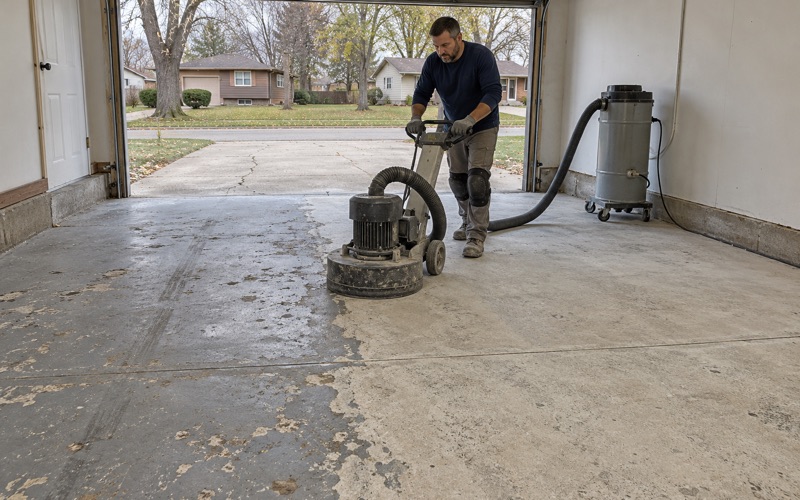
Once that work is finished and the slab is clear, we come back and start where any job starts. The concrete is ground to a profile in the ICRI CSP range the system calls for, with dust captured at the machine by a vacuum rather than washed toward the floor drain. Then the proposal is written with the product line, the number of coats and the finished thickness spelled out.
Testing first also keeps the schedule honest. Nobody arrives with a grinder for a floor that turns out to need a different contractor before us, and the price we give covers the slab we will actually coat rather than a guess about what lies under the carpet.
Choosing a system for a 1950s slab
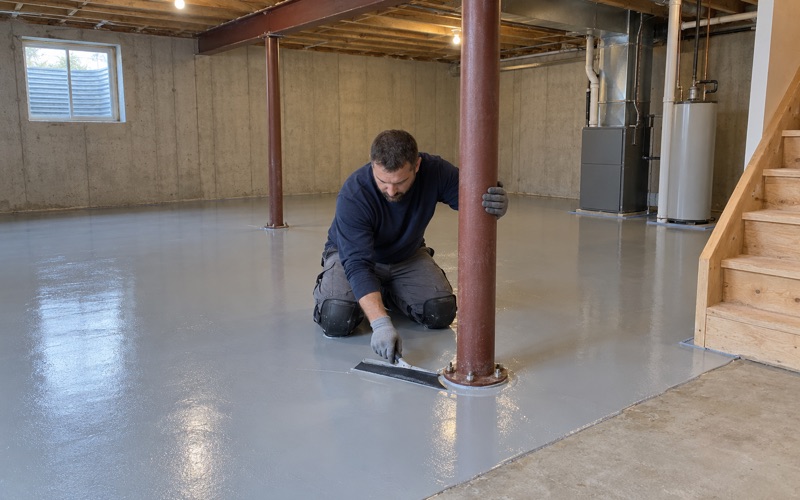
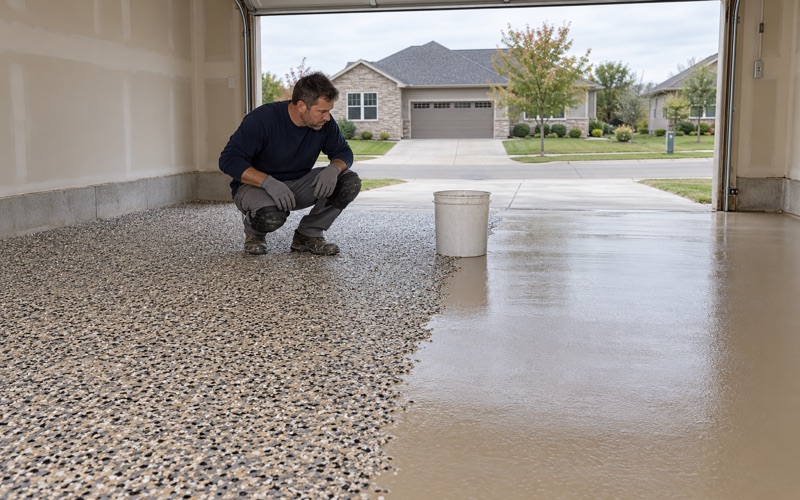
We do not assume an older slab has a vapor retarder beneath it, so the readings decide the primer. For basements we often pair a 100% solids epoxy with a moisture-mitigation primer when readings call for it. Garages get a broadcast of vinyl flake or quartz aggregate under a polyaspartic topcoat chosen to stand up to brine and rock salt from November through March.
Sixty-year-old concrete can carry settlement cracks, pitted patches and old paint, and we say plainly when a slab needs repair or replacement before it is worth coating. Freeze-thaw scaling near a garage door shows up on slabs that have seen decades of salt. Those repairs go into the written scope so the finished floor can be checked against it.
Cure timing follows slab temperature and the dew point spread, not the calendar, and an unheated garage in January is told to wait. We explain warranty exclusions before the job is sold, and moisture vapor transmission is the first one we name. Low-odor products are available for an attached garage or a basement as a comfort choice, not because Iowa requires them.
Who handles permits and sewer calls in Windsor Heights
The City of Windsor Heights contracts its permit and inspection services to Safe Building Iowa, and building permit applications go to the Deputy City Clerk at City Hall on 66th Street. The city keeps sewer inspections and sidewalk and driveway permits for itself, so a new driveway apron is city permit work. The city page does not address a coating on an existing garage floor, and we would ask before assuming either way.
A sewer backup through a basement floor drain is a call to city Public Works at 515-645-6825, or Westcom Dispatch after hours, and the city also lists the Urbandale-Windsor Heights Sanitary District. We coat around floor drains and sump pits only after leaks and backups are fixed. A floor coating is not waterproofing and does not protect a basement from water coming up through a drain.
- 20+ Years on Concrete
- Moisture Tested Before Pricing
- Ground, Never Acid Etched